Showing posts with label Granta Magazine. Show all posts

Friday, 24 May 2019

The Ungrateful Refugee

I was born in 1979, a year of revolution, and grew up in wartime. The itch in my brain arrived as war was leaking into our everyday – sirens, rations, adults huddled around radios. It announced itself one lazy afternoon in our house in Isfahan, between the yellow spray roses and the empty swimming pool, whispering that I might take a moment to count my pencils. Then, that night, it grew bolder, suggesting that the weight of the blanket be distributed evenly along my arms. The itch became a part of me, like the freckle above my lip. It wasn’t the side effect of this blistering morning at the Abu Dhabi United Nations office or that aimless month in an Italian resettlement camp. Those days simply made it unbearable.

Even in Ardestoon, my father’s village, where I tiptoed with my cousins along a riverbank, picked green plums in leafy orchards and hiked in mountains, the itch endured. It made me tuck my grandmother’s chestnut hair into her chador with the edges of my hands, circling her face and squeezing her cheeks until I was satisfied. It took up space in my personality, as the freckle did above my lip, so that now and then I tried to straighten the papery skin of my ninety-year-old nanny, Morvarid, pressing my palms across her forehead as one would an old letter. I picked everyone’s scabs. Zippers had to be forced past the end of the line. Sometimes when furious, the itch showed up as a tic in my neck. At other times, it helped me be better. It made me colour inside the lines. It made my animals sit in a row. I didn’t miss any part of a story, because I triple checked page numbers.

Now and then Maman joked that I was becoming fussy like Maman Masi and Morvarid, that I was becoming a tiny old lady. This was fine with me – I loved their floral chadors that smelled of henna, their ample laps and looping, gossipy stories, their dirty jokes. As a toddler, I marched around in an old flowery chador that Morvarid had sewn for me. I wore it so much it started to make my hair fall out. In a fit of anger, Maman tore it to pieces.

At school, my scarf was lopsided and my handwriting a disaster, but my math was perfect. The teachers in my Islamic Republic girls’ school were witchy creatures who glistened in brutal black chadors. They didn’t lean down and tuck in your stray hairs. They billowed past. They struck rulers against soft palms. They shouted surnames at six-year-old girls: Nayeri. Ardestani. Khalili. Shirinpour. The minute you turned your headscarf inside out to cool your damp neck, they appeared, swaddling your bare skin again with their own hot breath. The school was stifling and militant women were empowered to steer girls away from Western values – this made them cruel. If they didn’t like your work, they tore it to shreds as you sat humiliated, picking splinters off your unsanded desk. They taped weekly class rankings to the grey cement wall outside the classroom window. Every week twenty girls rushed that wall. The schoolyard was a concrete block. Opposite the classrooms was a putrid cave of water fountains and dirty squat toilets, the ground a mess of wet Kleenexes and cherry pits and empty tamarind packets that oozed brown goo into the drain. I liked to keep my back to it. But that meant facing the rankings, and if you turned another way you had the nightmarish Khomeini mural and, on the fourth wall, the enormous bloody martyr fist (and rose). The only way to have a safe place to look was to be number one on the rankings.

One morning, Khadijeh, whose name routinely appeared at the bottom of the list, released a quiet river of pee at her desk. She never moved. She sat still as her grey uniform slowly darkened below the waist, as drops of sweat released her bangs from her scarf and she wept without a sound. She had fallen three sentences behind in the dictée and given up, not just on the test, but on the whole business of civilisation. What a quick, uncomplicated solution, to go feral: to sit there, leaking, waiting to be dragged out by a murder of Islamic Republic schoolteachers, listening for the snap and swish of the principal’s chador down the hall.

On the day of Khadijeh’s quiet surrender, I was number one on the list so I had a place to look.

At day’s end, I took the short way home, down alleyways lined with drainage gutters where live fish travelled the old city. I ran to my room and thought of Khadijeh, how she had just let go. I pitied and envied her. I knelt to examine my pencil tips, then checked the bookshelf for the seven books I had recently bought and the four I had bought before that. It wouldn’t be right to count to eleven – I had to count the seven books, then the four. And the next time I bought books, say three of them, I would count the three, the seven and if I still remembered them, the four, each time I left my room. When I was finished, I breathed deeply until the thing floating too high in my chest (I imagined a metal bar) had moved back down, away from my throat. Years later, when I heard the story of Sisyphus, I said, ‘like pushing down the bar,’ and tapped my chest; my teacher frowned.

The following week, during silent reading time, a present arrived for me. This was custom. If you ranked high, your parents could send a gift to be presented to you in front of the class. Ms Yadolai, my first-grade teacher, an old woman I loved and whose name is the only one I remember, brought in the gift to my third-grade classroom. She was Baba’s dental patient, so he must have delivered the package to her. Baba never bothered with details; he entrusted everything to friends. It was a book of constellations. Everyone clapped. I lifted the lid of my desk and slipped the book inside next to my pencils and the tamarind packet I had squeezed from a corner and rolled shut, like toothpaste.

Khadijeh never came back.

I was instructed to work on my handwriting. I sat with Baba on the living-room carpet, an elaborate red Nain knotted on Maman Masi’s own loom; we ate sour cherries with salt and we practised. I asked Baba about Khadijeh. He said that everyone was made for a certain kind of work and maybe Khadijeh had realised early that school wasn’t for her. This is why I had to earn twenties in every subject, to distinguish myself from the Khadijehs of the world and to reach my great potential. ‘You are the smartest,’ said Baba. ‘You can be a doctor or engineer or diplomat. You won’t have to do housework. You’ll marry another doctor. You’ll have your PhD.’ His voice contained no doubt or worry. It was just how things were destined to be. ‘Your mother came in seventeenth for the Konkour. Not seventeenth percentile. Seventeenth person in the country.’ If I had to make a list of mantras from my childhood, it would certainly include: not seventeenth percentile, seventeenth person. My mother’s national university entrance exam result was legend. I came from test-taking stock.

We did such good work, Baba and I. He emptied his pockets of pistachio and chocolate and sour cherry and we sat together on the floor, cross-legged and knee-to-knee, whispering secrets and jokes as we drew bold, stouthearted Ks and Gs. I clicked our finished pages into my rawhide messenger bag and, the next day, I took them to show my teacher, a woman whom we called only by the honorific Khanom.

Khanom scanned my pages as I straightened up in my chair, my hands tucked beneath my haunches. She frowned and exhaled heavily through her nose. Then she glanced at the girls watching us from the edges of their scarves, tapped the pages straight against my desktop and tore them in half. She reached for my practice notebook and tore the used pages in that too, taking care not to destroy any unused ones. This was to show me that my work was worth less than those unfilled pages.

Tears burned in my nose. I imagined a metal storm-door shutting over my eyeballs, so that nothing could get out. I reminded myself of Khadijeh, her watery surrender. I imagined that under her chador Khanom’s skin was dry and scaly and she needed girlish tears to soften her, as she couldn’t afford black-market Nivea Creme. I tried to pity her for that.

A few years before first grade, my family had spent three months in London. There, my mother had converted to Christianity. Since our return, teachers had been probing me for information. Maman and Baba were respected in Isfahan. They had medical offices and friends and degrees from Tehran University. Maman had round, melancholy eyes and Diana haircuts in jet-black. She wore elegant dresses and a stethoscope. Her briefcase was shiny polished leather. No schoolgirl rawhide and click-buckle for her. But Maman was an apostate now, handing out tracts to her patients, a huge cross dangling in her windshield. Baba may have remained respected and generous and Muslim, but that wasn’t enough to protect me from abuse when I declared myself Maman’s ally.

‘What is your religion?’ the teachers would ask, every day during recess. They would pull me aside, to a bench between the toilet cave and the nightmarish Khomeini mural and they would ask this again and again.

‘I’m Christian,’ I would say. In those days, I thought Muslim literally meant ‘a bad person’, and no individual or event helped dispel that notion – not even Baba or his mother, Maman Masi, who was devout. We lived under constant threat of Iraqi bombs. We endured random arrests, executions, morality police roving the streets for sinful women (Gashte-Ershad or ‘Guidance Patrol’, they called it). Though they were picked off and dragged to gruesome fates, the underground Christians we had befriended seemed consumed with kindness. Meanwhile, my teachers pecked hungrily at us all day, looking for a chance to humiliate.

Later in life, far from Isfahan, I would meet kindhearted Muslims and learn that I had been shown half a picture: that all villainy starts on native soil, where rotten people can safely be rotten, where government exists for their protection. It is only amongst the outsiders, the rebels, foreigners and dissidents that welcome is easily found. Since our return from London, we had lost our native rights; we were exiles in our own city, eyes suddenly open to the magic and promise of the West and to the villains we had been.


*


We were converts in the Islamic Republic, illegal Christians in an underground church. We endured three nightmare years before the day of our escape – three years of arrests and threats, of armed revolutionary guards (pasdars or Sepâh) slipping into the back seat of our car at traffic stops, bursting into Maman’s medical office. Three years of daily terrors and Maman’s excuses about faith and higher callings.

It was a daily whiplash. The idyllic village life of my father on Fridays, sitting in my sweet grandmother’s lap, kissing her henna hair, listening to her reedy voice, eating her plum chicken or barberry rice, then travelling back to the city, to another phase of Saddam Hussein’s War of the Cities (a series of missiles that killed thousands in 1987 alone) that waited at our doorstep. Every few days sirens blared. We taped our windows and ran to basements, where we chatted in the dark with our neighbours.

That Maman chose this moment to become a religious activist out of her medical office baffled Baba – they fought night after night. Making a life after the revolution had been hard work. Baba had learned which patients to prioritise, which palms to grease, which tailor altered suitcases, whom to smoke with in relative safety. But now Maman hurried down unsafe streets pulling two children along, her scarf falling back as she slipped into strange doors to meet Christians. She broadcast her story over an illegal Christian radio station, tucked tracts into women’s chadors under the nose of the morality police and did everything a person could do to draw attention to her apostasy. Maybe she feels guilty, Baba thought. She had once been a devout Muslim and though she was never political, preferring to make her strict, conservative father happy, Maman had joined other medical students in the streets to protest the Shah, willingly covering her hair.

Teachers began to pull me away at recess. When I tried to opt out of weekly Islam classes, they held me in the schoolyard and told me that Maman would be jailed, beaten, maybe killed.

When I told Baba that Khanom had torn our proud, far-reaching Ks and Gs, his eyes flashed. My Baba was known for his pleasure-seeking ways: his riotous humour, his sumptuous feasting, his devotion to poetry. We were kindred spirits in our secret excesses. His vices, though, weren’t all bright and merry. He loved the poppy and it made him rage. His anger was slow to ignite, but God help you if you were the one to light him up.

The next day in the schoolyard, we lined up by grade and performed our required chants, straining our small lungs. An older girl, a fourth- or fifth-grader, pressed her lips to a bullhorn and led us in muffled pledges we didn’t understand: I am the daughter of the revolution. I am the flower of my country. Death to America. Death to Israel.

Then Baba stormed through the metal gate, striding in his Western shirt and tie past the Khomeini mural. In seconds the principal and two teachers were surrounding him, nodding, lifting and lowering hands. I could only hear snippets. ‘Yes, Dr Nayeri . . .’ ‘. . . I’ll speak with her . . .’ ‘. . . Sir, we’re in the middle . . .’ When old Ms Yadolai arrived, he calmed down, because she was sweet and harmless, like Maman Masi, his mother.

Then Khanom stepped out from in front of our line and started toward him. Suddenly she looked small, like one of us. Was she twenty? Twenty-five? She was trying to look strong, professional, but Baba was on a crusade. He wanted her heart. ‘She’s just a child!’ he shouted across the blacktop as he approached her at twice her pace. ‘You’re a grown woman. She isn’t responsible . . . She’s not your enemy.’ Khanom began muttering that this was only about the handwriting. Baba railed on. ‘She worked hard and I checked the work. How dare you! Where did you go to university?’

I noted that the last question was germane to the proceedings. That it affected her credibility, her allotment of power against my father. Baba was no sexist. If she had lifted her shoulders, bellowed out ‘Tehran University’ and defended her actions, if she had said, ‘Dina is chatty, fussy and odd. She has an itch in the brain and bad handwriting and one of her eyes is too small,’ he would have shown some respect for her methods. I know this because Baba – though he smoked opium and beat my mother and was incapable of lifting a finger for himself – instructed me never to cower to men. If you flinch, they will hit harder. Show your fangs, not your throat. But this was 1987 Isfahan and most Babas didn’t teach their daughters these things. The poor woman didn’t have the training.

She cried. She leaked before a man who shook his head at her and walked away, stopping to wave to his daughter who stood spellbound in a row of muppety grey heads, quietly growing a coarse new skin.

That night we walked along the Thirty-Three Arches and Baba took us to Hotel Koorosh, my favourite restaurant, where Baba and other local doctors had a membership. We ate schnitzel and crème caramel on white tablecloths. We drank yoghurt soda with three sprigs of mint. I knew now that my teacher wasn’t scaly or witchy or a demoness and that it was important not to bend. And I knew that I was capable of rooting for someone who wasn’t totally on the right side of a thing. In war, villainy and good change hands all the time, like a football.


*


A few days later, Maman was stopped in the streets by the Gashte-Ershad. We were at a traffic stop and my younger brother, Khosrou, opened the back door and jumped out into the madness of Isfahani morning traffic. I was in the front seat beside Maman, so I didn’t see him do it. All I saw was Maman throwing the car into park and hurling her body out of the car, dashing across three lanes and snatching him up. In the process, her scarf slipped back a few inches revealing half a head of loose hair. Then we heard the shouting, a pasdar was pointing and ranting at Maman. ‘Watch your hijab, woman!’ As he crossed the asphalt, his shouting grew louder, angrier. He began to curse, calling her vile names.

‘My son ran into traffic,’ she said. She had already fixed her hijab so that every strand was tucked away. But he towered over her, threatening, spitting. They stood by the open driver’s side door. If he had leaned in, he would have seen the huge cross hanging on her rearview mirror. Maybe he would have made an issue of it. He shouted a few more times, gave Maman a warning and returned to the other officers watching us from their car.

When he was gone, Maman’s cheeks glistened with rage. I wonder if she imagined herself in a country where men are punished for such things, where women can defend themselves. I wonder if she ever fantasised about slapping some fool hard across the face. Khosrou and I sat in that car, conjuring violent scenes. My brother glared silently at the car roof. Later he told Maman stories of how he would protect her, build her a castle in a mountain far away, fill it with Smarties.

Maman dropped me off at Baba’s dental office while she ran errands with Khosrou – my chronic motion sickness made me a terrible passenger. I slipped into the surgery, sat in the nurse’s chair to watch Baba fill a tooth. Long reddish hair fell over the back of the chair. I leaned in to get a better look. The patient wore a silky blouse and jeans. Her chador hung on a rack near my face – in Baba’s office, women could cover as they pleased if the door was closed. ‘Aren’t you going to say hello, Dina joon?’ said Baba.

I mumbled hello. Baba frowned. ‘Since when are you shy?’

I glanced at the woman’s red lips and made-up eyes. She was a stranger. And anyway, who can recognise a face with the mouth pried open? But then Baba leaned back and she sat up and spat. ‘Hello, Dina joon,’ she said. I knew that voice – it was my first-grade teacher, Ms Yadolai. Old Ms Yadolai, restored, it seemed, to twenty-five or thirty by some witch’s spell. ‘I saw you in the waiting room, telling everyone to shush,’ she said. ‘Where did you get that sweet nurse’s costume?’ She meant my photo hanging across an entire wall of Baba’s waiting room, my finger to my lips.

I shrugged. I was too transfixed by the miracle I was witnessing.

‘Dina, don’t be rude,’ said Baba.

‘I’m sorry,’ I said. ‘Ms Yadolai, what red hair you have.’

Little Red Riding Hood was one of few storybooks not banned by the clerics; that joke was well-worn. She laughed, thanked Baba and gathered her things. ‘See you in school,’ she said, whipping her black chador around her body, tucking at the temples. Despite makeup, she gained twenty years in one swing of her arm. A good scrub would cost her another twenty and all her power, returning her by morning to old Ms Yadolai.

Now, finally, I understood the function of hijab.

I started to believe that Christianity was feminism. Years later, my mother told me that when she had been a Muslim she was simply searching and Islam fit only some of what she held sacred. In Christianity, she found her beliefs in their purest form. I now know that I was searching for feminism and, along the way, I shed every doctrine and institution that failed to live up to it. Islam went first. Later, all religion would follow.

Our church wasn’t underground; it was behind gates and thick curtains. A rotating schedule in the homes of Assyrians and Armenians who, if they could prove their ancestry and refrained from proselytising, were theoretically left alone. Only apostates and Pied Pipers risked arrest and death. By allowing us into their homes, the Christian-born who hosted us tied their fates to ours and this bonded us beyond friendship.

News of pastors, even Armenian ones, being shot or disappearing into the notorious Evin Prison wasn’t rare. Political prisoners were routinely tortured and killed in Evin. We focused our attention elsewhere. Once we slipped past the front gate, headscarves came off and we sang songs and planned Christmas celebrations and heard funny sermons from our portly, heavily bearded Assyrian pastor, Brother Yusuf. The year we returned from England, Maman explained Christmas to us. She told us about Father Christmas and stockings by our beds and it struck me that this character sounded like an older Brother Yusuf.

‘If he visits all the children in the world,’ I asked, ‘why didn’t he come to us before?’ Maman told me that he only visited Christian children and now we were Christians, wasn’t that exciting? ‘But I didn’t know about Jesus before,’ I said. ‘You said Christianity is fair. If I didn’t know, why would he skip me? What about kids who are too young to have a religion? Does Father Christmas only visit houses with Christian parents?’

Maman blinked a few times. ‘Dina, it’s for fun. Maybe it’s Father Christmas. Maybe it’s Brother Yusuf in a costume. Do you want a stocking or do you want to sit in protest for all the ones you didn’t get?’

‘Yes, I want one,’ I said, and immediately suspended disbelief.

‘Good,’ she said, then added (as she often did), ‘keep asking these kinds of questions. You can think for yourself now; no more reciting.’

For a while I did this. I read my Bible, found inconsistencies and presented them to Brother Yusuf. I often asked my questions over meals at our sofreh, or his sofreh, with several families sitting around a feast on the floor. Brother Yusuf was the slowest eater I had met. He delighted in every bite – relishing and savouring and licking his lips, his big bearded cheeks bouncing as he chewed – nodded slowly and complimented the chef. He treated my questions as he would an adult’s, as if I were part of an important theological conversation. Though, he didn’t always solve my problem. Most contradictions were dispatched with one of two answers: ‘The rules were different under the Old Testament,’ or ‘That reads differently in the original Hebrew.’ It didn’t matter. The important thing was that he was impressed, that he called me clever.

When Brother Yusuf and the Christians visited, Baba disappeared to Ardestoon or stayed in his office – he despised Brother Yusuf, called him ‘that dirty Assyrian’ or ‘that bearded charlatan’.

Sometime in 1987, while the war raged on, sirens shrieked and the days thrummed endlessly with news of executions, Maman was arrested. I didn’t know the details, only that her office had been stormed, the patients sent home and she had been questioned for hours. She had been given a choice: spy against the underground church or face arrest and execution.

Maman and Baba fought. Baba threatened to take Khosrou and me away. One night, Maman took us to a hotel, but they wouldn’t accept a woman alone with two children.

Having found her purpose, Maman intensified her efforts. She kept stacks of Christian tracts under a thin blanket in her back seat, passing them out to patients and acquaintances. She started studying braille and sign language, so she could reach out to the deaf and the blind.

Maman was arrested again, her office ransacked, her records stolen. She grew rigorous in her domesticity, sewing complicated, lifelike stuffed squirrels and cats. She found thin mattress foam and made a stuffed car for Khosrou. As the gaze of the morality police grew hotter and more unbearable, she leaned heavier on the church and on Brother Yusuf. Sometimes when I spied on them talking in his home office, I detected an intimacy that felt like a betrayal to Baba – their talk was too playful. It was a strange habit of new Christians, these overly loving exchanges that were supposed to mimic brotherly or sisterly love. ‘My dear sweet’ this or that. Each time Maman met with the pastor, his office door remained wide open.

One afternoon, a car screeched to a stop behind the high wall separating the street from Brother Yusuf ’s front gate. His wife rushed out of the kitchen, scooping up her baby girl, Rhoda. His son, Yoonatan, and I stopped playing cards. Maman and Brother Yusuf stashed their Bibles away. Maman fixed her hijab. A hard knock shook the metal gate outside. ‘I’ll break it down!’ a man shouted. And though his voice was angry, almost violent, all my fear dissolved. I knew that voice and no matter how much he shouted and whom he threatened to hurt, it brought me only joy.

Khosrou was terrified, though. He screamed and jumped into Maman’s arms. He cried for a while, then his brow furrowed as if he were accepting new orders, a new role.

‘Don’t worry, Maman. I’ll protect you!’

Brother Yusuf had hardly opened the gate before Baba rushed in and grabbed him by the throat. He shouted terrible things. ‘You dirty Assyrian,’ he spat into the man’s face as he hovered over him, his shirt collar still in his fists. ‘Don’t you have your own wife to corrupt? Do you know what trouble you’ve caused?’ Why had Baba come today? Maybe he had been smoking, or had a visit from the moral police. Baba didn’t harm Brother Yusuf. He released his anger and, when the women managed to calm him, turned back toward the door, leaving Maman to apologise again and again.

The war made everything seem like the last of its kind. Every lazy afternoon, every family dinner, every drink of water. Some days at school, only a third of the students were present, the classroom eerily quiet and breezy, because parents had heard of a coming bomb raid.

My teachers reached in deep and planted gruesome images. They told me just enough to make me ask around and fill in the gaps. 1987 was a brutal year. For some, 1988 would be worse. Thousands of intellectuals, leftists and political dissidents disappeared that year, massacred by firing squad and hung from cranes, dying slowly. Sliced feet and skinned backs, hot irons to the thighs, their deaths covered up – it was a purge unprecedented in Iranian history. These images competed in my nightmares with scenes from the Book of Revelation and movies about the rapture: horsemen and plagues and the Antichrist. Which was the worse fate? Did most eight-year-old girls have such choices?

I decided to talk to my teacher, to make peace. One day after class, I waited for the room to empty, straightened my scarf, checked my area and meandered to her desk. ‘Khanom,’ I said. She didn’t look up from her papers. ‘I’ve been practising my handwriting.’

‘Good,’ she said, her head still down so that all I saw was the grey fabric lump of her head. ‘That’s why we’re here.’

‘I didn’t tell Baba,’ I said, trying not to let my dignity leak away. ‘He looks at my notebooks. I didn’t . . .’

Now she looked up with her stony eyes, folding her arms over her papers in a rehearsed, wooden sort of way. ‘Miss Nayeri, the world is brutal for women. It’s a thousand times harder than for men. Whatever our private conflicts, we don’t betray each other to men. Do you understand?’

I shook my head. ‘Baba isn’t one of those men. He was just angry . . .’

She rolled her eyes, capped her pen and sat back. ‘Who’s your biggest rival in the class? Who do you hate more than me?’

‘I don’t hate you, Khanom,’ I said. What a terrible mess this was.

She waited. I didn’t want to answer, because Pooneh was also my best friend and a distant cousin. I loved her and craved to beat her so much that sometimes when we kissed hello, on both cheeks as our parents had taught us, I squeezed her face hard to calm my itching teeth. It was a painful, confused affection like a Mafia boss kissing a rival brother goodbye.

Now Khanom smiled. Even though I came in first twice as often as Pooneh did, I was the one always chasing, because I was the one who publicly cared, while she shrugged and smiled and puffed her porcelain cheeks. That I would have to suffer another twenty years of sprinting alongside Pooneh exhausted and thrilled me. ‘Whatever you do to each other to win,’ she said, ‘the minute you run to a man, you’re a traitor.’

Then she went back to her work. ‘I’m sorry,’ I said, though I felt that the story had been unfairly rewritten. ‘I’ll do the work over. I do love you.’

She gave me a strange look. I had said the wrong thing. You don’t tell teachers you love them. Why had I said it?

For a moment, we both stood our ground, Khanom determined to ignore me, as I remained planted in her line of vision. I shifted onto my other foot, moved my messenger bag to my back.

She glanced up again, smiling kindly now. ‘It’s OK, Miss Nayeri,’ she said. ‘I’m OK. I’m stronger than you think.’ She made muscle arms under her chador and we both laughed. ‘How would you like to do a very special job that only the top students can do?’

My fingertips went cold – I knew my school’s rituals and rewards and yet I wanted so much to please her. She lifted herself off the chair with a weary sigh and opened the book cabinet behind her. She pulled out a piece of paper tucked beneath the red bullhorn. When I didn’t move, she waved it at me until I reached up and took it from her.

‘You can lead tomorrow’s morning exercises,’ she said. ‘Don’t be sad.’ She leaned down to my height and touched my cheek. ‘We’re friends again.’ Then she hugged me and muttered encouraging words in my ear. She smelled like my mother’s soap and I wrapped my arm around her neck. Under her chador, a familiar lump comforted me; a ponytail, bound low, hanging down to the top of her shoulders. It made me trust her: yes, my teacher was a person. Her body wasn’t covered in scales. She had real hair tied up in a girlish ponytail. I didn’t want to stop touching it, but a moment later she pulled away.

I slogged home in cement shoes, feeling the breath of the four horsemen on my neck. Was there any way to escape hell if I led a schoolyard full of girls in chanting death to Israel, God’s own people? I might as well drive the nails into Jesus’s hands and feet. I pictured Rhoda and Yoonatan, Brother Yusuf savouring my mother’s Salad Olivieh and strapping on his Father Christmas belly. I would be betraying them all.

Alone in my bedroom, I agonised. I took off my uniform and dropped it in the laundry basket. I sat at my desk, tried to do math through tears. How would I survive tomorrow? Aside from damning myself to hell, it would be humiliating. I had been so brazen and boastful about my new faith. A few hours later, Maman burst in. ‘What is this?’ she said. She was holding my manteau in one hand, the scrap of paper with the chants in the other. ‘Why is this garbage in your pocket?’

The metal bar was so far up my throat now that I could hardly take a breath. I confessed everything. ‘You cannot do it, Dina,’ she said, then she went on to repeat the story of Peter denying Jesus three times and Judas and every other betrayer in the Bible and in history. ‘When the class lines up for chants, what do you normally do?’

‘I don’t say them. I ask Jesus for strength, like you told me to.’

‘You tell your teacher that your mother forbids you. Tell her that in our faith we don’t recite things. Don’t argue with her about the text. Then get back in the line and do as you always do, OK?’

I nodded.

The next day, I dragged myself to school. I separated from my body with each step and by the time I passed through the school gate, crossed the blacktop and climbed the podium, I was numb and limp, hovering outside myself. I was already in Baba’s car speeding toward Ardestoon, toward my Morvarid’s withered henna arms. The stage was only inches from the ground. I read the words into the red bullhorn, barely waiting for the back chant. I conjured up the blond London boys who had punched me and severed my finger and I thought, maybe viciousness is genetic; maybe some people, like British boys and Persian girls, are bred for it.

When my volume dropped, a teacher straightened my back and the bullhorn so that it touched my lips and I tasted plastic and metal. I said the final words and started back down the podium to join my class, stopping as I passed to return the paper to Khanom. The moment the last syllable dropped like phlegm from my mouth, I began praying for forgiveness; I prayed all day. I never told Maman what I had done. Maybe she knew. It took months to escape the nausea of that morning and even then, I was marked: long after the Islamic Republic, the war and the refugee years had receded and I had become an ordinary American, I would still be someone who once stood on a podium in an Isfahani schoolyard and shouted Death to America into a bullhorn.


*


For a few weeks in the spring of 1988, everything was on apocalyptic pause – that’s how it felt when sirens warned of bombs already on the way. A pause as we looked up to the sky, waiting for word that our daily labours were worth continuing, that in an hour we would still have homes and schools. Or bodies. The television blared out insanity – was it propaganda or had the producers succumbed to madness? I shiver at the memory of a drama in which two boys with shaved heads and long white robes, good Muslim boys from less sophisticated cities, walked through the bombed-out rubble of their neighbourhood looking for the bodies of their parents. They passed a weeping man carrying his son’s limp body – their friend. When they stumbled upon a wreckage that had been their roof, they sat atop it and cried, caressing the ground, now a family gravesite, with the sacred touch of new orphans. This drama played at 3 p.m., during children’s hour.

I couldn’t breathe. I didn’t deserve to breathe. Nothing was mine to keep. ‘Maman,’ I ran to her and cried into her skirt. ‘Tell me a riddle.’

School was a ghostly place, nearly empty now. The teachers didn’t bother with lessons. We sat in lonely silence and wrote. During breaks, we wandered the hallway and the blacktop one by one. No groups remained. Pooneh didn’t come. I missed her. I needed her to make me try my best.

‘A worthy rival is a precious thing,’ said Baba.

‘You shouldn’t compete with anyone but yourself,’ said Maman.

Had there been a day when these two agreed on one single thing?

Isfahan grew quiet and sad. People tiptoed, exchanging ration coupons for basics and rushing home, taking their tea to the bomb shelter. The New Year slowed things down. It brought smoked fish and spray roses and tiny pink buds, but little hope. We cocooned in the church and listened to news of our murdered brothers and sisters and we prayed for rescue.

Meanwhile, in the Ministry of Intelligence, one man was making Maman’s case his pet project. She was arrested a third time in her office, thrown in jail for the night. Next time, the man said, if she didn’t agree to disclose church secrets, she would be executed. Baba paid them to release her into house arrest. As she was leaving, the man promised Maman that tomorrow she would have her final chance to accept his offer, or she wouldn’t return home again. That night, police cars surrounded our house.

Maman didn’t sleep. She packed. ‘We are leaving. I know we are. This is the moment when Jesus will perform miracles.’

Khosrou grew tense, his little brow always furrowed. It seemed he would have to act fast, if he were to build Maman that castle in time.

‘Your Jesus is going to save you?’ Baba bellowed. ‘At least admit that the person performing the miracles will be me. I’ve lost my family because of this lying, grifting, Pied Piper man. Please be sure to thank him for me.’

The arrival of this day struck Baba like a rock hurtling down a mountain; he had tried so hard to keep that boulder moving upward. But now Maman was taking his children, abandoning him, her country, her life.

Baba spent the night on the phone. Maman in prayer.

The next morning, to allay suspicion, Baba went to his office as usual and I walked to school. A handful of teachers and girls in halfhearted hijab roamed the halls. In class, we read silently and I left early. At home, I packed my things. The itch pawed and suffocated me. I stared at my animals and books all lined up, my solar system and the Victorian doll with folds in her dress for hiding secrets. I couldn’t bring the squirrel with its furry white belly, or my cat, elephant, or duckling. They would be safer here, Maman had told me. Remember Babaeejoon?

I clenched my fist around some dried sour cherries, warming and loosening there, staining my palm bright red. I stared into a drawer of dried berries and fruit leathers. I ate the hot cherries in my hand.

Despite everything, I was excited to go: beyond our borders lay every kind of possibility. If I could just pull myself away from my things . . .

We waited in the kitchen for my Uncle Reza – my father’s younger brother. Baba had sent him to fetch us in a borrowed car. A few months before, we had moved from the house with the pool and the spray roses. Now we lived in a third-floor flat and the plan must have been to climb down the fire escape and leave from the back.

Reza was thirteen when I was born. Now twenty-one, he had soft chestnut hair and a lazy smile, faded jeans, the kind of youth and freedom that Iran granted only to some men and only briefly. I couldn’t imagine a more heroic person. On Fridays in Ardestoon, Reza would put me on the back of his motorcycle and we would whiz through the countryside, past rivers with ducks and orchards full of sour cherries, mulberries, almonds and green plums, to a mountain where sheep grazed. The back of that motorcycle was peace for me, a place of no worry. It was freedom, my hair flying as I clutched his stomach and screamed into his shoulder. How would I live without those afternoons? Who would be my new Uncle Reza? What if it took him years to follow us? What if he never did?

At the kitchen table, Maman underlined her Bible in a third or fourth colour (one for each year). I began to panic about leaving. I had two months left of the third grade. I’d have to learn English. How long would that take? How could I be number one in school if I didn’t speak English?

‘Maman,’ I said. She continued to read. ‘Maman!’

She looked up. ‘What is it?’

‘How do you say the word “write” in English?’

She told me, then frowned and said, ‘Why?’

‘Because,’ I said, ‘math will be the same, but during dictée, the teacher always says, write this, write that. So if I just listen for “write” and sound out what comes after . . .’ After three years of Iranian dictée, after Khadijeh, I divided tests into two kinds: the easy kind and the kind with a chadori teacher breathing down your neck, shouting sentences that must be written verbatim in calligraphy, with a fountain pen.

Maman laughed. ‘English spelling isn’t like that. You’ll see.’

Reza arrived just as sirens began screaming. We watched the surveillance cars from the kitchen window; they hesitated, then scattered. ‘Let’s go,’ said Reza. A lucky crack had opened in Maman’s house arrest; I held my favourite uncle’s hand for the last time and we ran through it.

We scrambled into the back of the car with our suitcases. The street was deserted, just a long sun-streaked hollow where I played with the neighbourhood children. Blurred by rain and tyres and shoeprints, our chalk hopscotch ladders still coloured the street from top to bottom. We weren’t going far on this leg of the journey. We would fly to Tehran, then drive to Karaj, where we could hide in the home of Maman’s elderly grandmother (Moti’s mother). She had pillows lining a wall beside a small television, a bed-ridden husband and cherry trees that would be blossoming now.

Earlier that morning, before he left for work, I had asked Baba, ‘When are you coming?’

‘Soon,’ he said. ‘I’ll come to Karaj.’

Uncle Reza drove us past Baba’s building; his office was on the third floor, his operating room facing the street.

‘Wave goodbye to your Baba,’ he said, his voice too quiet and low.

I squinted at the man in the window and waved. I knew the window, the big chair beyond, the desk with our photos scattered under glass. I couldn’t see his face. We were in a moving car and he was three storeys up.

In the front passenger seat, Maman stared at the streets with grieving eyes, taking in every shop sign and utility pole. Waving to Baba had unnerved me. Maman always told me the truth. She told me about her arrests, the death of church leaders. But now I understood that we were sealing a door even tighter than I liked, that I’d never again see this life from inside. I may never sit beside my cousins, glance for my name above Pooneh’s, or tuck in Maman Masi’s hair. Morvarid would die without me.

I made promises to myself. If we made it to the United States or England, I would work twenty times harder to avoid Khadijeh’s fate. I would learn English and become exceptional. In the West, the criminals wouldn’t be in charge. Teachers would be kind. Worthy rivals would abound.


The above is an excerpt from Dina Nayeri’s The Ungrateful Refugee, a timely, provocative and personal examination of the refugee experience that is available from Canongate Books on 30 May.

Image © Hamed Saber

The post The Ungrateful Refugee appeared first on Granta Magazine.


from Granta Magazine http://bit.ly/2VGK3Q4

Binyavanga Wainaina


I first met Binyavanga in 2013. He came to the Granta office, hair shaved and dyed. Was it yellow, in part, and maybe purple? I can’t quite remember, but I do remember his warm dry hand, and his direct, complicit, gaze. We talked for a while, and then, laughing ironically, he asked me to sign the latest issue of Granta. No-one had ever asked me that before, and I was moved by the implicit intimacy of his request. We had already published his memoir, which I loved, One Day I will Write about this Place (2011), and, among others, a satirical piece for the magazine, ‘How to Write about Africa’ (2005). This started as a letter to the editor, protesting about Granta’s 1994 issue on Africa, which, he wrote, was ‘. . . populated by every literary bogeyman that any African has ever known’. That’s probably right. I have that issue in front of me now – it’s mostly white voices, and ends with a piece by Nelson Mandela, filled with the sincerity of the time, Mandela’s particular tone, defining the moment of liberation: ‘Thus must we build on the common victory of the total emancipation of Africa to obtain new successes for our contintent as a whole and prevail over the currents that originate from the past, and ensure that the interregnum of humiliation symbolized by, among other things, the destruction of Carthage, is indeed consigned to the past, never to return. God bless Africa’.

Binyavanga’s ‘How to Write about Africa’ is a satire on objectifying platitudes, subtle, powerful, and mordantly funny. It’s our most widely read piece ever – we have published nothing that has been as influential or successful. I read from it at the launch of our 40th-Birthday Special at Shakespeare and Company in Paris the other week, and remembered Binya:

Always use the word ‘Africa’ or ‘Darkness’ or ‘Safari’ in your title. Subtitles may include the words ‘Zanzibar’, ‘Masai’, ‘Zulu’, ‘Zambezi’, ‘Congo’, ‘Nile’, ‘Big’, ‘Sky’, ‘Shadow’, ‘Durum’, ‘Sun’ or ‘Bygone’. Also useful are words such as ‘Guerillas’, ‘Timeless’, ‘Primordial’ and ‘Tribal’. Note that ‘People’ means Africans who are not black, while ‘The People’ means black Africans. [. . .]

When your main character is in a desert of jungle living with indigenous peoples (anybody short) it is okay to mention that Africa has been severely depopulated by Aids and War (use caps).

You’ll also need a nightclub called Tropicana, where mercenaries, evil nouveau riche Africans and prostitutes and guerrillas and expats hang out.

Always end your book with Nelson Mandela saying something about rainbows or renaissances. Because you care.

The last time I saw him he had already had his first stroke. He was working on an ambitious undertaking, too ambitious, probably. He also sent me many pieces by other writers, generously advising and helping them. One, a prose poem about homophobia, ‘Africa’s Future has no Space for Stupid Black Men’, we published. But Binya needed help himself. He was sick, and he was tired. I want to say that he remained himself, in some essential way, but he would have hated that, seen it for what it was, a well-meaning cliché. I appreciated that stubborn spirit, the refusal to give in, as well as his warmth, directness, and intelligence. He saw through things, and came out the other side.

This is what he wrote, turning down a World Economic Forum ‘Young Global Leader Award’ in 2007:

‘I assume that most, like me, are tempted to go anyway because we will get to be “validated” and glow with the kind of self-congratulation that can only be bestowed by very globally visible and significant people, and we are also tempted to go and talk to spectacularly bright and accomplished people – our ‘peers’. We will achieve Global Institutional Credibility for our work, as we have been anointed by an institution that many countries and presidents bow down to.

The problem here is that I am a writer. And although, like many, I go to sleep at night fantasizing about fame, fortune and credibility, the thing that is most valuable in my trade is to try, all the time, to keep myself loose, independent and creative . . . It would be an act of great fraudulence for me to accept the trite idea that I am “going to significantly impact world affairs”.’

He could have become a poster-boy for liberal literary Africa, a ‘cultural personality’, but he resisted turning himself into anything other than what he was: a writer, and an editor. And yet he had a profound influence, through Kwani?, his literary magazine, through his refusal to accept the othering of Africa and Africans, through coming out in a homophobic society and through advocating for feminist principles, for the idea of ‘upright Africans’.

I look through all my emails from Binyavanga, mostly written on his phone, praising this writer or that, sending pieces, and yes, asking for help. I did help him – but did I help enough?

I don’t know. I wish he was still with us.

The post Binyavanga Wainaina appeared first on Granta Magazine.


from Granta Magazine http://bit.ly/2JWj5Sm

How I Write My Books


I have long kept notebooks. I ponder matters there, not on a daily basis, but regularly. It’s the way I work. Then, one day, I let go of my notebooks because a novel is underway – a novel that, on the face of it, has very little to do with what I have been noting down over the months.

What determines the start of a novel is a sentence that pops up all of a sudden and seems to me to contain an entire book. For there are sentences you produce one day – it’s rather mysterious – which carry within them a story that accounts for everything you know and have experienced in life, and articulates these matters more effectively than you could ever do in any other medium than the novel.

This means that gathered together in sentences of this kind is your entire life, with all your memories and impressions, and all the books you have read, suddenly simultaneously present and alive.


*


How is that first sentence made? The only thing I know about its production (for there seems to be something miraculous about it each time, and no reason, therefore, why it should ever happen again) is that it requires on my part months of silence and solitude, a form of inner tranquility, and close attention to what is taking shape inside me.

How do I recognize a sentence that contains one of my novels? Because, however scrawny and insignificant it might appear – and there are times when it looks like nothing at all – it’s always packed tight, like an egg in its shell: you couldn’t fit anything more into it. It makes a sound, the ‘sound of my life’, as it were. That particular form of recognition, where you have the impression of recognizing the ‘sound’ of your life, is virtually impossible to explain.

The day the sentence, ‘I was seven the first time I saw my father dressed as a girl’, popped into my head – it’s the opening sentence of The Wishing Table – it was packed tight, like an egg in its shell. Contained in that sentence was my entire life, both real and imagined, all the books I had read, all my memories and impressions. That strange sentence contained my life, even though I had never, of course, seen my father dressed as a girl when I was seven.


*


The moment that first sentence has been written down (for it has to be written down; if I just store it away nothing comes of it), a sort of parthenogenesis or self-fertilization kicks in, whereby each sentence brings forth the next with relative ease. Then interspersed with this are scenes I have imagined, and scraps of memory. What’s interesting at this point is how well my imagination and memories get along together, as though they had been waiting for one another, waiting to meet in order to form the story. This may, in fact, be what is happening in that mysterious first sentence: all of a sudden there’s this perfect romance between the imagined and the experienced. Proust’s famous opening sentence ‘Longtemps je me suis couché de bonne heure’ is emblematic of this, I think.

As I narrate the scenes of a novel, very often I’ll recognize characters from previous books of mine, who reappear under different names and in different situations, or someone I knew in the past though wasn’t particularly close to, or a scene, a house, a landscape I’ve seen in a film, or a character from someone else’s novel, though I won’t be able to remember which novel it is.

In short, what I come across when I write is a patchwork, but one which, bizarrely, appears to be cut from the same cloth, and a cloth that is new and without a snag.


*


Generally speaking, I always get held up in the middle of the book. Right in the middle. It’s become so systematic, in fact, that I now know that if I’m stuck at page fifty, the book will be a hundred pages long; when I’m held up at page eighty, it will be a hundred and sixty pages. This almost always happens, and it’s to within a page. And since I have the impression when I write that I’m going on a long walk or climbing a mountain, I deduce from this that it’s when I reach the top that I take a break.

At this point, things get stressful, where previously everything had been going well. It’s as though I don’t know how to find my way back down, as though I can no longer see a path. The last sentence on page fifty or eighty has failed to bring forth the following one. The system of parthenogenesis or self-fertilization has stalled.

I do find what comes next, but only after trying several different paths and taking several wrong turns – trying to advance the story, that is, when I can no longer feel it or see it, when it’s no longer alive. So I return to the last point where it was alive and start searching again. Things carry on like this for five or six days: each day I write five or six pages, and each morning I do away with the five or six pages from the previous day and go back, once again, to the point where the story was still alive.

Eventually I found a little trick – at the time of my very first book, Les gouvernantes (The Governesses). In order to continue, I needed to invent a counterfeit sentence so perfect that even the text would be taken in by it. In other words, the text had to mistake the sentence for a sentence it itself brought forth. At this point, one might say that my text, which up until then I had been on good terms with, becomes an enemy, or at any rate an opponent. I have to hoodwink my text into thinking a moon is a sixpence. That is why in the middle of my books, there is always a counterfeit sentence, a sentence that gives the impression of being genuine – lively, heartfelt, fully formed – but is nothing of the sort.

Once I’ve managed to hoodwink my text, I can resume my journey, and the sentences start bringing each other forth again without difficulty. Nevertheless, I have to be very careful at this stage, more careful than on the way up, because, like it or not, I’ve committed a sort of crime up there on the mountain (to pass off a counterfeit sentence as a genuine sentence is a crime in literature), and at any point the text might realize and swoop down and swallow me up and – who knows? – get its revenge. A bit like in Prosper Mérimée’s The Venus of Ille. So I keep a low profile until I reach the end. I make my way back down as though descending the slope of a live volcano.

Perhaps that’s why Thomas Mann called literature The Magic Mountain. It’s not just his novel he calls by that name, but literature as a whole. I imagine that Mann was frightened of being swallowed up by writing, since his was a mountain that people couldn’t come back down from, and longed passionately to die on. But perhaps in The Magic Mountain there’s a counterfeit sentence, too. A sentence that pretends to be alive, pretends to be part of the text, but is actually entirely fabricated, a bridging device.


*


When writing a book, I’m more interested in what arises out of my imagination than in the memories that emerge. In part this is because my imagination surprises and amuses me, but above all because it is so much more knowledgeable than me. When what I’m writing is based on a memory, I’m aways eager to see what imagined passage that memory will open onto. I always have the impression that I experienced the event I’m recalling as fiction – like one of my own fictions, in fact. With memories there always comes a rather disturbing moment when I no longer know if I experienced such and such a scene or if I wrote it. I wouldn’t say, like Marguerite Duras, that ‘what is written replaces what has been experienced’; if anything, I’d say the reverse: that what is experienced has already been written, even before it turns up in a book. And that once it turns up in a book, there is virtually no difference between memory and imagination, because they are woven from the same cloth. Memory has turned into fiction, but the event in question may itself have been experienced as fiction – like a book or a dream, or even a novel you were in the process of writing while the event was unfolding. There may be a way of living, my own way perhaps, that consists of believing that what is going on inside you and all around you is actually a novel you’re in the process of writing.


*


To come back to the little technical hurdles you come across when writing a book: the main one I encounter is ‘branching’, because a sentence will often bring forth not just one, but two or three others. You have to choose one, the one that will take you right to the end, for the other two don’t go right to the end, but lead to dead-ends. It’s exactly like a maze: there’s only one way out. So it’s not unusual that I go astray and choose a sentence that is perfectly enticing but leads to a dead-end five, ten or fifteen pages later. At which point I retrace my steps, delete the pages I’ve written and choose the other sentence, which I have sometimes been careful enough to keep present in my mind. I spend more time paring away than expanding: I tend to cut back rather than develop. This is true even though, my master in these matters being Kafka, I always strive to exceed the limitations of a completed scene or paragraph. I always try, that is, to take things a jot further, because contained in that jot is something very precious.

Most days (once I start on a novel I work on it every day), I read the whole thing through before taking up where I left off. As I write fairly short books, this is not too difficult. During the writing, the part already written is always entirely present in my mind, with its details and micro-details. I’d be unable to advance, I think, if I didn’t have constantly present in my mind the overall shape, the movements, volumes and spatial geometry of the part already written, with its minute shifts in tone, shading, lighting and rhythm, even when these are not obvious to the reader. The ‘subject’ of the book preoccupies me very little. It’s the object’s composition that’s my main concern, because the truth and presence of the book, the consciousness it conveys, resides mainly in its composition; in the wording, and in the thinking behind it.

Last and by no means least is the all-important question of the ending. Where will I stop? When will I stop? A story, as we know, is never finished, since narrative time is not the same as chronological time. Writers work – quite simply – in eternity. There comes a moment, however, when the book itself is packed tight like an egg, and to pursue it further would damage it and undermine its presence.

Often I’m torn between the desire to have done with it, and even to have done with it as quickly as possible (in his wonderful lectures on the novel Roland Barthes, you may recall, says that writers only begin a book in order to end it), and the desire to remain in the novel as long as possible, so at home do I feel there, so perfectly at home. I write dozens of pages more than I need. These are a holiday where I pretend to myself I’m still in that Eden where the imagination plays with memory like a child. Some of those pages are quite good, but they’re not the book, they’re no longer the book. So I have to make drastic cuts, which is another thing I always end up doing. Then, for a few weeks after the final full-stop, just for the fun of it, I continue to imagine ways of prolonging the book, though I know, at heart, that it can’t be done. For once you have left the maze, you have left it.

After finishing Le cheval blanc d’Uffington, which was published in 2002, I wrote in one of my notebooks that ‘completing a book was like returning from the land of the dead’. There’s certainly an element of truth in this; you’ve been playing with ghosts, and I don’t believe in novels that don’t play with ghosts. At the very least you’ve been through an unusual psychological experience. And then, before you know it, it all starts again: the long, secret preparation, the long secret ceremony of preparing the opening sentence that will contain your entire life, and off you go again.


The above is an edited version of a talk given at the literary festival Les Écrivains du Sud in April 2013. It was first published in French in the review Études, in May 2016.

Image © Archie Binamira

The post How I Write My Books appeared first on Granta Magazine.


from Granta Magazine http://bit.ly/2WgKe9j

Thursday, 23 May 2019

Four Poems


How to Get a Gibbet Through the Small Hole

It ain’t going sideways that’s for sure. And truth be told, it probably ain’t going lengthways either unless you really know what you’re doing; plus if someone’s hanging from the rope then you’ve got to factor that into your calculations before you even embark on the manoeuvre. The first thing to say is there’s no point in working the gibbet itself through the aperture and then finding that the fragile cadaver firmly noosed on this end of the rope won’t go through. In fact you’d be in real difficulties then as you won’t extract the gibbet back out once you’ve got it through, because it’ll just be hanging there any-old-how on the other side and you’ll never get it properly aligned to come back again, so you’ll have a stiff on this side of the hole, and a gibbet on the other side with the rope connecting them. What are you going to do then? Look round over your shoulder with a ‘can anyone help’ raised eyebrows expression on your face? I think not. And I imagine, if you’re honest, you probably think not too. No, I’d actually recommend starting with the corpse itself. Feed the body slowly through the hole, feet first obviously, and both feet mind – don’t try getting one foot and leg through and then starting on the other one or you’ll get in a frightful salmagundi and possibly break something. Then once you’ve given the dead patsy’s head a last gentle push, and he’s popped through and is safely dangling in the other bailiwick, out of harm’s way, you can start on the gibbet itself, which is less susceptible to damage, so you can fiddle about with it with carefree abandon, and conceivably even begin to derive some modicum of pleasure out of the whole enterprise.


The Dragonfly and Berries

Perhaps, like me, you live in a house with two
staircases. Well good for you if you do because they’re
almost always the larger types of property, and so
living in one suggests you are probably fairly affluent.

Another reason it’s propitious to live in habitations
with two staircases is the opportunities they provide
for the occupants to surprise each other.
For example, one person might wander off in front

of another, and then appear suddenly behind them
like an apparition and cause them to shriek
and throw the laundry all over the wolfhound,
or throw the dachshund all over the secretary.

One other good reason to live in a house with
two staircases is that you can spend time lying
in bed of a morning wondering which might be
the shortest route to go down to the dining room

for the kippers, and perhaps you’ll measure
the two options by pacing them out in fairy steps,
or if you’re like me you might ask one of the interns
to do so on your behalf. But the best thing of all

is only to wait until people are out on errands or
holidays or visiting the neurologist, and then to run
round and round the house, up the backstairs,
across the landing with the faded fauteuil,

past the doors to the bedrooms, then down the front
stairs to the hallway, and through to the kitchen with
the half-plucked woodcock, and back up the backstairs,
across the landing with the faded fauteuil and the books

on the table, past the bedrooms, down the front stairs
to the hallway, and then through to the kitchen with
the half-plucked woodcock on the long pine table,
and back up the panelled backstairs,

across the landing with the faded fauteuil
and the books on the table and the Alcaraz rug,
past the doors to the bedrooms and down the front
stairs with the painting of the dragonfly and berries

to the hallway. And that’s where you’d find me
talking to the aerial photograph interpreter,
except that it’s me who’s running, just look
at me go, how marvellously happy I am!


Trees, Breeze and Rabbits

Trees are made out of wood in
a deplorable waste

of a scarce resource that could have
been used to fashion cots for orphans,

or wooden legs for victims
of industrial accidents.

Just look at those nasty trees flaunt
their leaves, each one a tra-la-la.

‘Suck it up!’ say the trees,
and the giggling breeze wantons

in their leaves.
What a horrid nincompoop,

what a waste of space the breeze
is, with its heartlessness

and its insubstantiality!
And the rabbits, each, in itself,

just a small portion of meat,
but add them all up, add up all

the world’s rabbits, and then
they’re one enormous bunny.

A behemothic rodent which could
mindlessly hop on top of my house

and crush my wife and children
as well as myself as I attempt

to rescue them. I hate you all,
trees, breeze, and most of all, rabbits. 


As Though Begat, but Not

My you-train
toy-real

all stocked
in her station

What am I like
State – state-away peppercorn

I’m mostly ears
a sudden god gone happy

This life of ours
it’s grinding out poor dear old train

It’s grinding out poor


Mark Waldron Sweet Like Rinky Dink
These poems are taken from Mark Waldron’s collection Sweet, like Rinky-Dink, published by Bloodaxe Books.

Photograph © curiously_unique

The post Four Poems appeared first on Granta Magazine.


from Granta Magazine http://bit.ly/2QfGteT

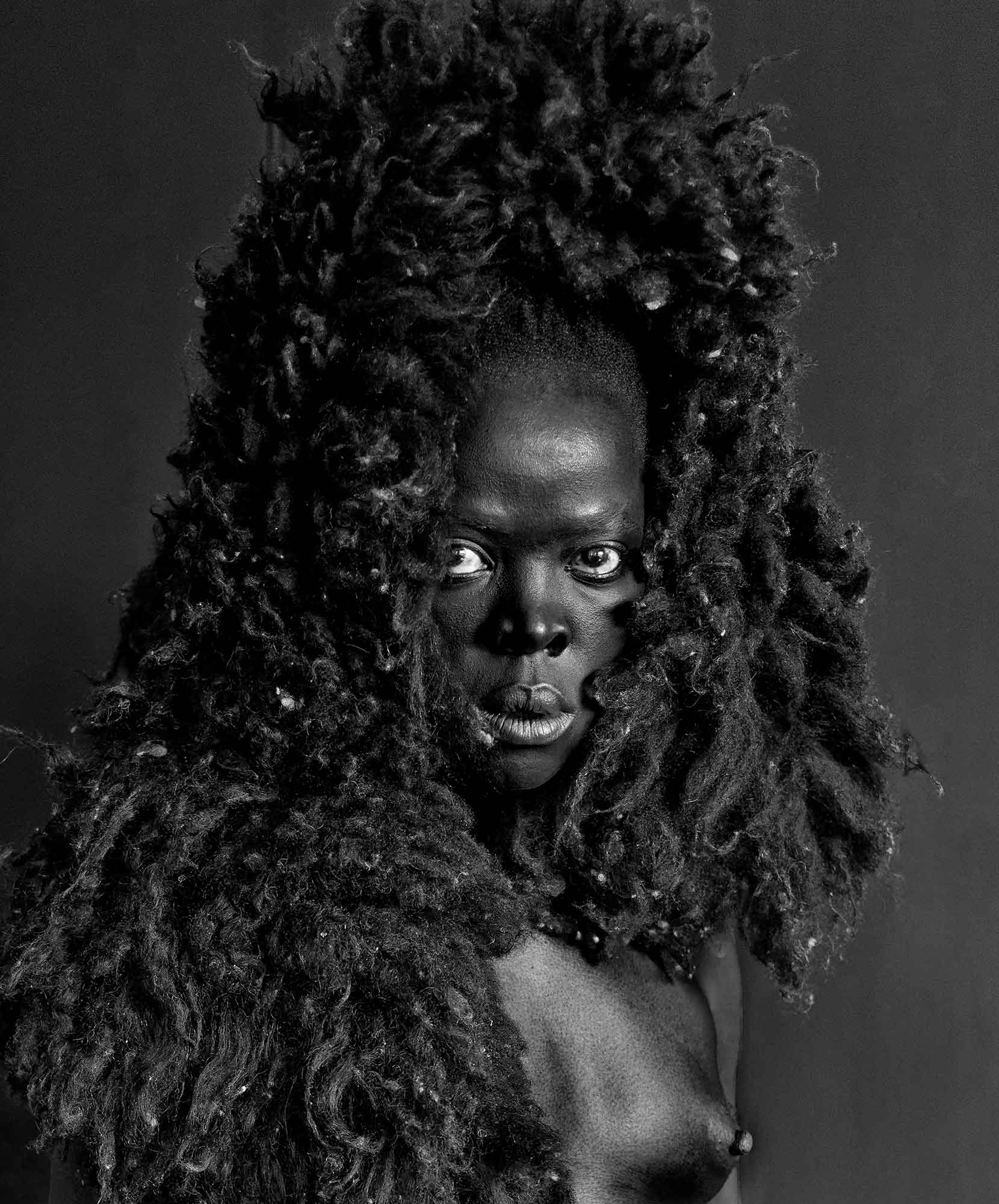
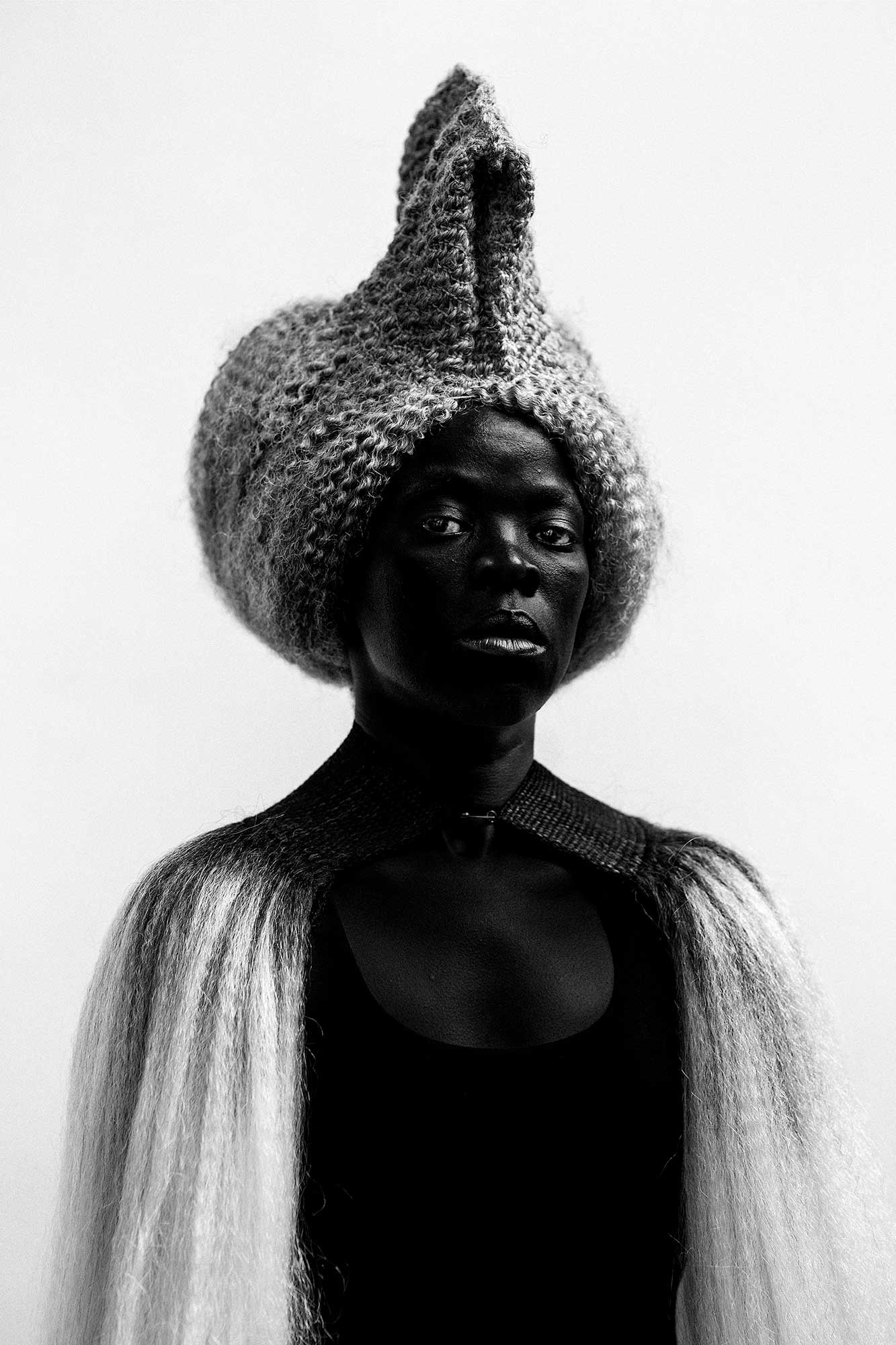
Zanele Muholi: Somnyama Ngonyama, Hail the Dark Lioness

Zanele Muholi: Sonnyamma Ngonami, Hail the Dark Lioness | Anne McNeill | Granta Zanele Muholi: Sonnyamma Ngonami, Hail the Dark Lioness | Anne McNeill | Granta Zanele Muholi: Sonnyamma Ngonami, Hail the Dark Lioness | Anne McNeill | Granta Zanele Muholi: Sonnyamma Ngonami, Hail the Dark Lioness | Anne McNeill | Granta Zanele Muholi: Sonnyamma Ngonami, Hail the Dark Lioness | Anne McNeill | Granta Zanele Muholi: Sonnyamma Ngonami, Hail the Dark Lioness | Anne McNeill | Granta


‘The stare, bold as brass
Says: NO
What you see is not there
What is, is I
I – Zanele Muholi’


These commanding words, by the distinguished storyteller Sindiwe Magona, are an extract from the poem ‘Black and White’, one of the twenty-six text pieces published alongside Zanele Muholi: Sonnyamma Ngonami, Hail the Dark Lioness. Muholi’s series of powerful self-portraits is the winner of the 2019 Kraszna-Krausz Best Photography Book Award.

Who is the I? Who is Zanele Muholi?

Born in 1972 in Umlazi, South Africa, Zanele Muholi is a photographer, often described as one of the most powerful visual activists of our time, and a long-time advocate for their black LGBTQ+ community.

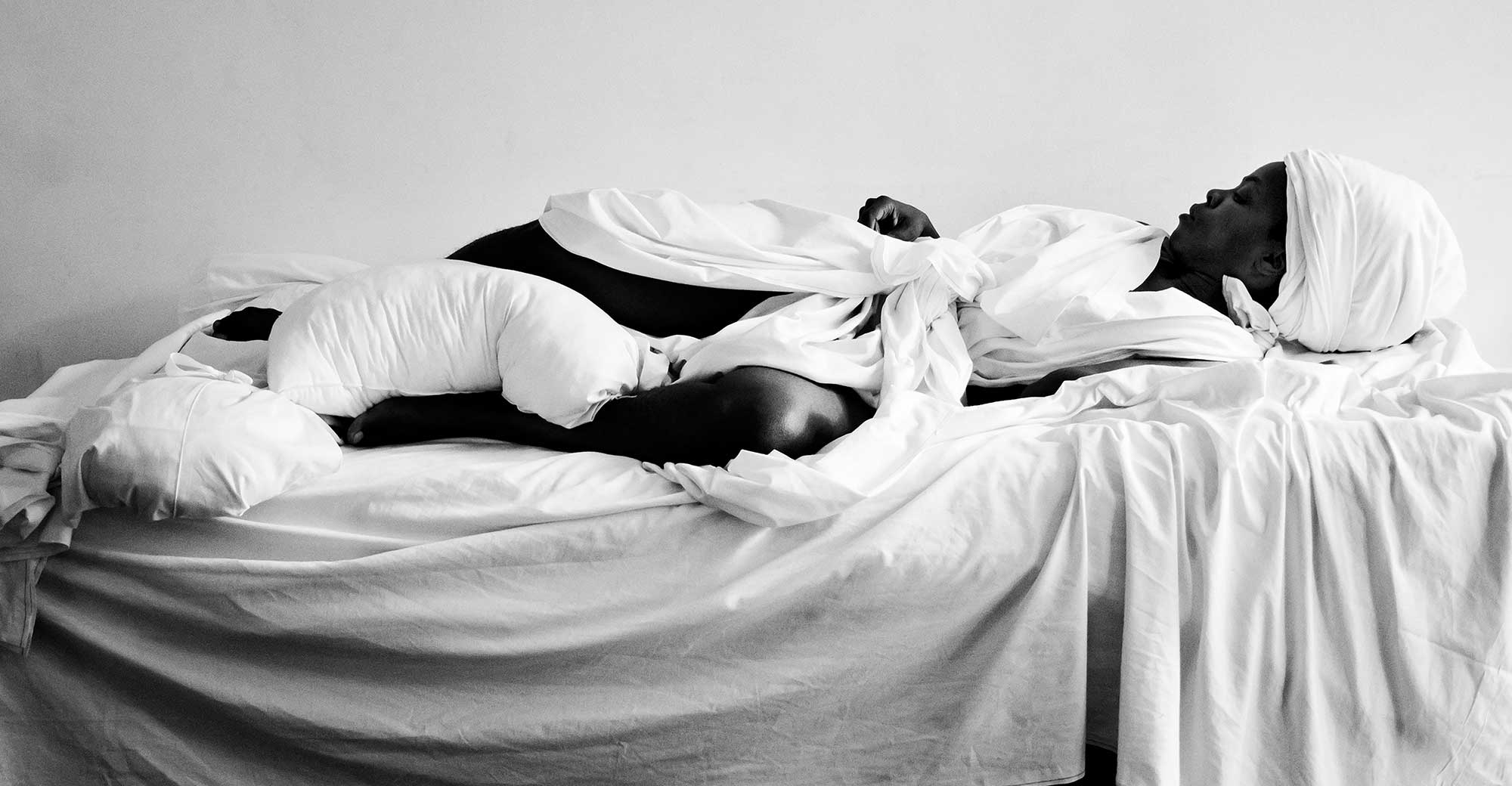
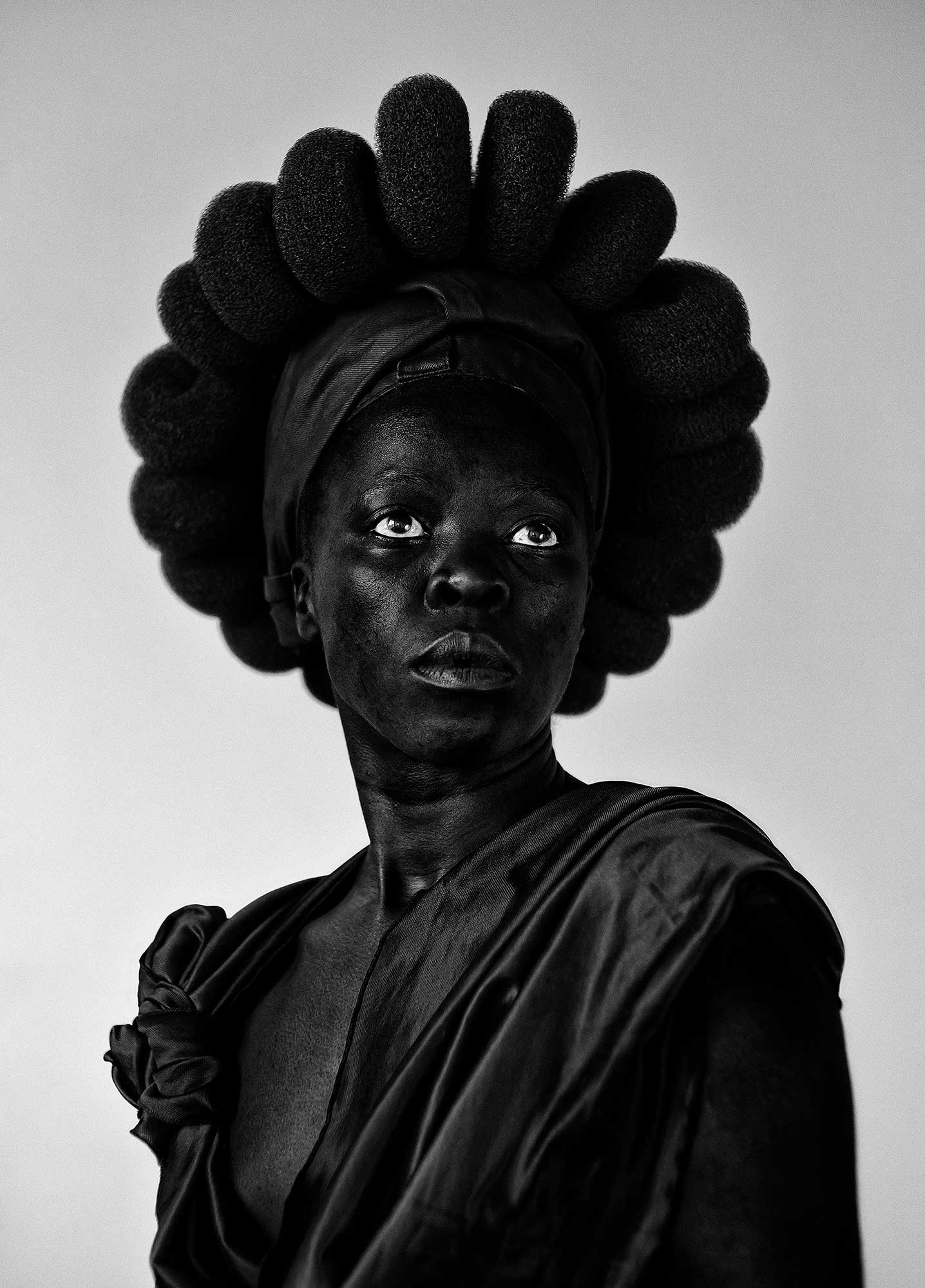
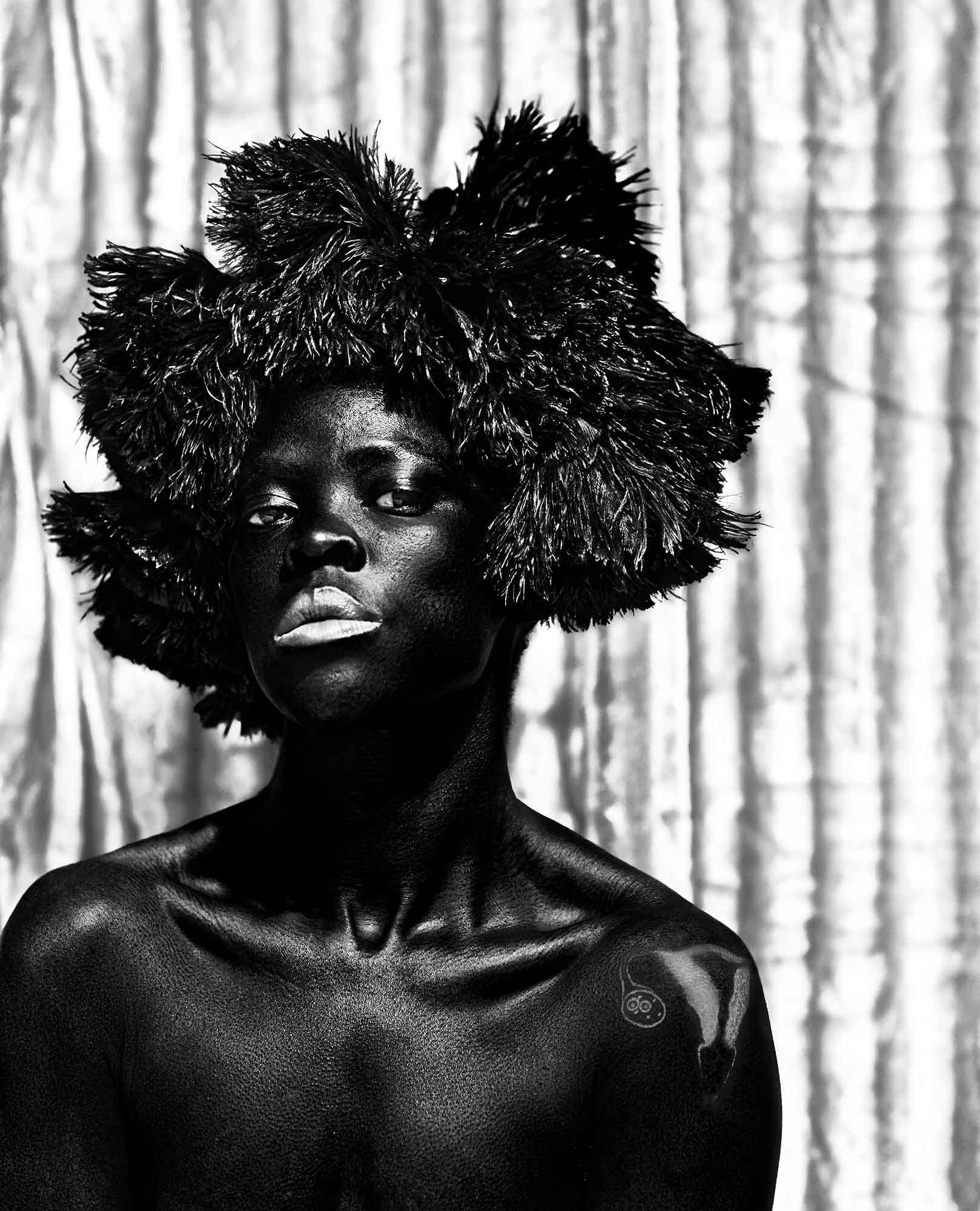
Zanele Muholi: Sonnyamma Ngonami, Hail the Dark Lioness is a collection of one hundred black-and-white meticulously constructed images in which the artist has turned the camera on themself. As Muholi explains, ‘I am both participant and image-maker . . . confronting the politics of race and pigment in the photographic archive.’

Photography often gives permission to watch, to stop, to stare and to observe. Muholi’s penetrating self-portraits permit the viewer to bear witness to a person who appears and re-appears in different guises.

Their images are performative; props are employed to evoke memories of the past and dreams of the future. Muholi is the drama, and their characters take central stage. Their black face, their eyes fixed on ours, becomes our focal point, forcing us, the viewer, to confront our political views on race, culture and identity.

One portrait is named after Muholi’s mother, Bester Maholi (1936–2009), who as Tamar Garb writes ‘worked all her adult life in the kitchens of others, raising their children and cleaning their stuff, scrubbing and scouring their pots and pans so that her hands became rough and her back became bowed with the labor and love that she gave.’

Muholi-as-Bester looks at straight at us, their gaze defiant, making it difficult, for us, the viewer, to turn away. Their hair is gripped by wooden clothes pegs, mimicking a crown. Their earlobes are adorned with the same set of clothes pegs, earrings that pinch and hurt. Around their shoulders hangs a shawl held together by yet another peg, a symbol of domestic labor. This is a love letter to the artist’s mother, this is a love letter to all the female domestic workers who spent their lives cleaning the homes of others, and to all those who suffered and survived apartheid.

Social and political resistance is integral to Muholi’s work. Each self-portrait is a commentary on a specific event in South Africa’s political history. Their gaze is always steadfast. These photographs are powerful statements of courage and endurance.

The black, dark materiality of each photograph is important, every one showing us a person who is unapologetic in their blackness and who is comfortable in their dark skin. As Muholi says, ‘By exaggerating the darkness of my skin tone, I’m reclaiming my blackness. My reality is that I do not mimic being black; it is my skin, and the experience of being black is deeply entrenched in me.’

Zanele Muholi: Somnyama Ngonyama, Hail the Dark Lioness is a judicious and timely statement on race, gender and identity, and as such this book has an enduring presence that will be appreciated and valued by future generations.

Anne McNeill


Artwork © Zanele Muholi, courtesy of Stevenson Gallery, Cape Town/Johannesburg, and Yancey Richardson Gallery, New York

The post Zanele Muholi: Somnyama Ngonyama, Hail the Dark Lioness appeared first on Granta Magazine.


from Granta Magazine http://bit.ly/2Qbmspx

Thursday, 16 May 2019

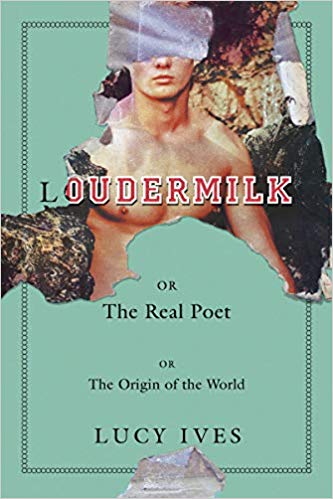
Loudermilk

It is the first introductory BBQ of the fall workshop season, a time of new beginnings. The younger bard Anton Beans, emerging conceptual lyricist, the, who is he kidding, heir apparent to the poem-based sector of the American humanities multiverse, hovering beside the condiment table, is finally about to get across to Marta Hillary, award-winning poet and faculty member, the central conceit of his second, as-yet-unpromised manuscript, The Noise of Noise. Beans, who has been in the program for a year, arrived already under contract. His first collection, Distillation Metrics, will be published in May by a small but extraordinarily reputable press. Beans is all but guaranteed to secure academic tenure within the next five years, and he knows it. The only reason Beans temporarily abandoned San Francisco for the Midwest was to study under Marta, who is not just renowned but quite possibly the greatest poet of her generation. If she were not at the Seminars, he’s not sure what the point of his malingering here among so many reactionaries would be, although perhaps the degree itself is worth something.

Beans is twenty-eight years young. He has a PhD in linguistics and, before he left the Bay Area, was toiling very lucratively in consultation with certain IT interests, though he says nothing of this to his Seminars cohort. Beans is not a great fan of his fellow poetry students, in particular, nor is he a great fan of the arts, in general. As a toddler, he was pushed into show business. Beans appeared in a string of camera commercials before the onset of a stubborn form of childhood irritable bowel syndrome made his, albeit glowing and cherubic, face, due to its relative proximity to said bowels, unemployable.

From this early career loss, Beans learned the importance of a plan B. In his last year of grad school at Stanford, Anton Beans used some of his consulting fees (he, for the most part, was able to steer clear of options) to invest in real estate back in the city, buying a building on 24th and Mission. He knows exactly what he is sitting on, where it’s going in the next couple of decades.

Anton Beans is in some ways fairly unconcerned about his future. His ambitious mother, meanwhile, is pondering a second marriage to a cunning contractor.

What keeps Beans up at night is his own historical significance. He is not an academic, though he was happy enough to follow through with his degree. He isn’t really even a writer.

What it means not to ‘really’ be a writer: It’s not that Beans can’t write, because he definitely can, but that he does not exactly see the point, if you see his point, which it is unlikely that you do. If you understand anything at all about mankind these days then you know that the entire race has a rapidly approaching expiration date stamped on its forehead. All this business about symbolism and getting something or other eternal across to the sensitive souls who choose to buy your puny book is just so much outdated twaddle as far as he’s concerned. It’s a pipe dream of pre-network Romanticism.

All the same, Beans can’t quite rule out the importance of reading. And the fact that he can’t convince himself that the work of reading has no power and no allure and no gravitas suggests to him that there’s something he, Anton Beans, can and should do with the rest of his time on earth as far as literature is concerned.

Poems are good for Beans’s purposes because they’re short, because he can engineer a poem exhaustively, can attempt to determine its semantic capacity in a complete sense. His favorite writers are Gertrude Stein and Ezra Pound, individuals who, interestingly, did not seem to particularly care for each other.

Beans likes to dress as his own personal approximation of an anti-retinal, postwar American artist, basking in the soft power that comes of eschewing figurative content and, later, objects altogether. He would never bother living in inflationstruck New York City at this point, but he thinks Sol LeWitt’s appearance in the Cold War gallery system was pretty neat. He enjoys the utter primacy accorded the ‘concept’ by this exalted man. Beans stands with LeWitt, against rhetoric, against expression. Long live ‘the square and the cube as . . . syntax’! Long live logical sequence. Long live the beauty of evacuated form.

For the BBQ, Beans is wearing a pair of studiously, delicately paint-soiled white jeans, a white T-shirt, and white canvas sneakers from which he has painstakingly removed the logos using an X-ACTO knife. He began shaving his head bald several years ago and compensates for this elective scarcity by encouraging a pleasingly thick, wiry black beard of anarchic proportions to obscure his neck.

Beans is pretty sure that Marta does not know what to make of him, but that her refined and at least partially unconscious powers of pattern recognition have convinced her of his intelligence. He, for his part, would like: First, to secure a letter of recommendation from her, and, then, with this out of the way, to attempt to understand what makes her tick. If he were not currently practicing celibacy as a form of mental and spiritual self-discipline, it is likely that the two of them would be making love on a daily basis.

Marta is drinking white wine from a small green glass she must have brought for herself from home. Beans hovers at her side. Marta smells – he thinks, uncharacteristically employing simile – like an ocean breeze traveling along the tip of a rosebud. In fact, she is sex on a stick. Her face is small with a long, straight nose. Her jewelry makes elegant sounds.

‘So my procedure,’ Beans begins to explain, but here something very, very unpleasant occurs.

An enormous male-model type in a hot-pink hat inscribed with an obscene slogan appears at the condiment station. Beans’s fragile web is disturbed as Marta’s interest shifts. The bro has a pair of plump dogs over which he deploys nauseating quantities of ketchup, nodding approvingly to himself. A couple yards off, a weird, undersized person who looks a lot like a fraternity torture victim due to fading permanent marker drawings on his face, and who must be the wingman of the philistine, is miserably peeling the label from his beer bottle.

Marta turns away from Beans.

It is like this scumbag thinks Marta is another student, albeit one aging gracefully into her mid-forties via a budget that permits investment in Prada and the occasional foray into Comme des Garçons. And the truly frightening thing is that Marta seems to like it! She smiles that slow, dreamy smile of hers and offers the goon her hand. She greets him as if she remembers him from somewhere, which, if Anton Beans permits his worst fears momentary realization, must be his application to the program.

‘Troy Loudermilk,’ Marta says. ‘Welcome.’

The piece of shit is saying, ‘Welcome to you, too.’

‘Yes,’ Marta tells him. She makes no effort to introduce herself, rather examining the face of Troy Loudermilk. ‘You look so different?’

‘That’s funny,’ this most complacent of oafs replies. He is fussing with a pickle jar.

‘I meant, from how I’d imagined you,’ Marta finishes. ‘I never look at the photographs. It’s barbaric the university even makes us ask our students for them. The unaccountable needs of bureaucrats!’ Some stronger sentiment seems to flit across her face but is quickly dissolved under another indolent smile. ‘Lovely to see you.’

The kid with the cross on his forehead is staring at the ground so hard he may burn a hole into it. Beans likes him, if this is possible, even less than he likes Troy Loudermilk. Why someone like Loudermilk would put up with a specimen like that is a curious case. Probably has something to do with needing to seem plausibly human while you walk around looking like a boxer-briefs commercial.

Troy Loudermilk is saluting Marta. ‘Bye!’ he says, grinning moronically. He bears his submerged wieners away.

Marta watches Loudermilk go. ‘That is a very great poet, or so I believe.’ Marta eyes Beans. ‘We’ll have to see if he can live up to his potential.’

Beans forces himself to smile, he hopes enigmatically. ‘Anyway, about the manuscript,’ Beans recommences, ‘what you were saying was so –’ But he stops.

Marta has glided off. Beans is incensed to see her standing now in the company of Troy Loudermilk, Loudermilk’s presumably foot-long schlong, and Loudermilk’s bizarre minion, the last of the trio having already succeeded in smearing the entire lower half of his face in Heinz.

Beans watches Marta nod, watches her rest her shapely hand on Loudermilk’s shoulder and leave it there. More than anything else, Anton Beans hates the lucky. Not only do they absorb all the top prizes in life’s insipid games, but they have the habit of doing very little work in the process. Anton Beans abhors the lucky. They are the cherry on the top of humanity’s miscreation.

Beans turns to the cooler, roots furiously for a seltzer.


loudermilk lucy ives
 Copyright © 2019 by Lucy Ives, from Loudermilk: Or, The Real Poet; Or, The Origin of the World. Excerpted by permission of Soft Skull Press.

Photograph © green kozi

The post Loudermilk appeared first on Granta Magazine.


from Granta Magazine http://bit.ly/2JHc8o2

Lucy Ives and Niina Pollari In Conversation

Lucy Ives is the author of the novel Impossible Views of the World, and of many mixed-genre works, including nineties and The Worldkillers. She has also contributed two stories to this magazine. I have admired her work and ability to connect the literary dots since I first met her in 2009, when she ran an extraordinary reading series in Ridgewood, Queens. We talked via email about her new novel Loudermilk: Or, The Real Poet; Or, The Origin of the World, a book in which a chiseled flimflammer takes a distinguished MFA program by storm with the reluctant participation of a talented agoraphobe.


Niina Pollari:

Let’s start with the when and where. The time in which you set the book is recent enough to remember well, but also feels like a totally different era, a time when Britney Spears kissing Madonna was shocking and the internet was almost quaintly unobtrusive. What drew you to set the book then, and why does a character like Troy Loudermilk flourish in 2003? Could he exist in 2019, when everything is a scam?


Lucy Ives:

It’s a good question. I think the burgeoning popularization of the internet in this historical moment is one key to understanding the worldview of my main character, Loudermilk, who is an oddly low-stakes con artist. Loudermilk’s imagination is at once limited and limitless: He can have a vision of ‘taking over’ a poetry-writing program by means of his own good looks combined with the literary excellence of his ghostwriter/poet-proxy, but the spoils he gains through this elaborate scam (involving moving halfway across the country and lying to people all the time about something he knows very little about) are a meager graduate-student stipend and health insurance.

Loudermilk has a certain amount of information about the world and how to manipulate it, but perhaps not too much – certainly not as much with someone with a will and a browser today. He’s just coming to understand the possibilities implied by email and other platforms affording fungible identities online. He’s thinking a lot about the power of avatars, but he’s not all that clear on what this means. He, like everyone else in the US at this time, has just watched as a war was sold to the public using completely cooked up ‘proofs’, aluminum tubes with ambiguous applications and fake vials of anthrax and so on. There’s a feeling of fantastical flexibility in this moment, combined with a naiveté regarding history I think younger Americans, who have watched this war that was new in 2003 wind violently on and also experienced the financial crisis of 2008 (not to mention the election of the current president), no longer possess.

But I do think that (putatively/in theory) in 2019 Loudermilk is still going strong. Only by now he’s respectable.


Niina Pollari:

‘Respectable’ is such an interesting concept – of course he would be respectable now. He would likely have a large following on Twitter.

So Loudermilk is a hot dummy, albeit a street-smart one. You describe his friend Harry, the reluctant brains of the operation, as undersized and generally unattractive. This made me think of the medieval conflation of goodness and beauty. How much were you working from archetypes in these characters? There are certainly archetypes in MFA programs (i.e. ‘guy in your MFA’); how did that come in to play? I also must ask if you drew from your own MFA experiences.


Lucy Ives:

Loudermilk has a particular idea about the classroom. Poems are tokens exchanged in a game played by avatars called ‘authors’. Loudermilk knows that originality doesn’t matter; it’s all about authenticity. He sees how undergraduate poets are trying to give their personal suffering form. But he’s such a damaged person that when he sees this he just starts looking for a way to monetize it. Like, Oh look, my classmates’ tears are an amazing renewable resource! Loudermilk finds someone who is suffering and whose suffering he abets. He enables his friend Harry’s agoraphobic tendencies and constant low-level panic, even as he pretends that he’s trying help Harry. He creates a situation in which Harry is isolated from other people, a sort of factory for lyricism. This partnership, if you can call it that, between Loudermilk and Harry, allegorizes something I saw in real poetry workshops when I was an MFA student. Students were encouraged to make themselves vulnerable and praised, in turn, for self-exposure. Often the teacher hadn’t developed a more sophisticated take on what a poem is. In these classes, you were effectively trapped in a nineteenth-century paradigm.

Thus, Loudermilk isn’t just a type of MFA student. He’s the one MFA student you would never, ever meet. He’s impossibly aware of how the system functions, not just at the level of the administration, but at the very level of genre. Loudermilk gets genre in a preternatural way, and he sees that the program is hardwired to be exploited by someone who understands the lyric as he does. Also, as one of his classmates notes, he looks like an underwear model, so he’s that guy, too.


Niina Pollari:

I will readily admit that my last question included a reductive summary of these two characters for the sake of creating a duality. Really this book seems to me to be about watching Loudermilk – Harry watches Loudermilk interact in person (and via taped conversations, if listening can be watching); other characters watch Loudermilk to try to solve what they think is the mystery of him. And Loudermilk understands and uses his own inherent watchability. Could you talk a bit about watching and identity in the novel?


Lucy Ives:

I think ‘inherent watchability’ is a great phrase. Loudermilk is indeed a very visible guy.

Regarding identity: Whether this program is entirely homogeneous, there’s a way in which its curriculum assumes a kind of reproduction of a white, hetero, middle-class existence, with the difference that the person who’s participating in this existence is an artist (rather than a white-collar worker). Of course, who gets to be an/the artist is in question. This seems to be part of the reason that two of the main characters, Marta and Don Hillary, who are married to one another and who are both instructors in the program, are about to get divorced. The problem in their relationship is that Marta, who is younger than Don and was originally his student, turns out to be the better poet. In some unspoken code maybe only Don cares about, he’s supposed to be the real poet in the relationship, and she was only supposed to be his hot student, but it turns out she’s very successful. He’s still teaching in the program with her, but he’s not doing as well.

The program was founded by a (fictional) man named Rainer Dodds, who famously had a special relationship with Henry Ford. Dodds was interested in the mid-century cultural ascendency of America. The poets who came after him in the program all wrote the kind of poetry that received critical attention in academia during each of their lifetimes. It was very orderly. Each of the poets had a personal critic, and whenever one of the poets published a book a great review would come out in a prestigious journal, and everyone would be like, Oh goodness this program has the best poets, everything makes sense! My guess is that there started to be a problem around Don Hillary’s generation. Marta, a woman, appeared as the star instructor-writer, and it made the program start to fall apart. This is what Loudermilk is encountering, and there’s a sense in which maybe Loudermilk is going to be the one to show the program that it doesn’t actually have to change. That’s the awful hope. The other students are not consciously aware of this. Many of them are conciliatory and admire their teachers and just want everything to go well, so they aren’t thinking about all this stuff very critically. And this is what makes it possible for Loudermilk to exploit their watching.


Niina Pollari:

Marta and Don’s relationship is fascinating, and so tiring to think about, especially given all of the context you provide in this answer. And it’s certainly there in the reading – you give every named character a weight and a developed personal story, even if you don’t reveal everything about them. Rainer Dodds, who is a huge part of the mythos of the Seminars, is mentioned once, I think. I read in the afterword that you worked on this book for a long time, and imagine you cut a great deal – what is your revision process like? I’m especially interested in the removal aspect, given that you’ve created such a complete world. How do you decide what to leave out?


Lucy Ives:

I’m sorry if I went on a bit long about Marta and Don. I do seem to know a lot about them! And Rainer Dodds. (More I could tell you about Dodds, too, like that he was named after a certain poet and at one time had a Polish last name that was anglicized.)

Regarding revision: I recently discovered about forty-thousand words of a novel that I was writing around the time when I began Loudermilk. Loudermilk was originally just a subplot in this novel, which had the working title of, of all things, ‘Realism’. I groan typing this. ‘Realism’ was about a man who teaches writing at an American university, who is writing a novel about two idiots who attempt to defraud an MFA program. I can’t believe I’m telling you this. It was not a good idea! I eventually saw that ‘Realism’ was a boring campus novel and that I should just get rid of this frame and concentrate on Loudermilk, which was really my novel and which was where the action was, anyway.

This anecdote gives a sense of how I do a lot of the thinking that allows me to write fiction: Most of my stories and my two novels have come out of thinking about some setting in which writing or artistic creation could occur, and the narrative, so called, emerges from this imagined nexus. For me, narratives are always tied to and emerging from other narratives; there is no single beginning, no origin. So on some level you have to sort of flip a coin or hope that the voice that comes to you will give you permission to (gently) separate it from its siblings and other sorts of contexts. This is also why both of my novels contain so much media and inset writing: poems, short stories, other documents; descriptions of images, archival metadata, traces of the internet and so on. Everything I write wants to be with something else.


Niina Pollari:

‘Everything I write wants to be with something else’ is a perfect summary. And Don and Marta are only tiring to think about in the sense that I know that story from being in an MFA and dating poets and being a woman and living in America. But your writing is not tiring in the least. In fact, something we have not yet talked about is that this novel is also really fucking funny. Your particularity with detail is sharp and absurd – I laughed on the train as I read the passage where drunk Don casually sings ‘She’s Homeless’ by Crystal Waters while he putters around in the kitchen. And Loudermilk’s speech patterns – you deploy bro-talk at the level of a native speaker, and it’s brilliantly funny. What’s the role of humor in your work, and what kinds of things are funny to you?


Lucy Ives:

I’m glad that the book made you laugh. I really want readers to laugh; I wrote many of the scenes feeling a mixture of rage and mystification, at what the characters were willing to do, how poorly they understood themselves. I wanted to bring those mixed emotions into a space/form by means of which I could share them with other people. Laughter seems to signal that we have understood something together. Or, since I know that there are many kinds of laughter, I wanted to draw pictures that would cultivate a sort of laughter that might make me, the writer, and you, the reader, feel less alone. I’m not sure what it is that we are in together, but I do think there’s something in laughing when you read that generates a feeling of connection – and you realize that this connection was there all along, even before you read the thing that made you laugh and even before you laughed. This effect also seems to hint at a series of relationships: between and among politics, art and the unfolding of language in time. The US has long been famous for its humor – but lately I haven’t been finding things that make me laugh in the way I most want to. Much of the time I catch myself laughing knowingly or bitterly. Although this novel might give rise to some knowing and/or bitter laughter, I don’t see it as primarily concerned with that sort of relationship between affect and public life. I want it to drum up a thrilling sort of laughter and maybe even a warming sort of laughter. I want to help, if this is not presumptuous of me to say, with the tension we experience and with despair.


Niina Pollari:

This makes sense to me. I don’t think, in 2019, I can find anything solely funny. It’s always mixed with something else. I’m also not drawn to comedy, so when something is funny, it’s a surprise. This book made me laugh several times, and it definitely triangulates toward a kind of humor that is shared and experience-based rather than detached. This seems optimistic to me, so I wanted to know – do you feel your work is optimistic?


Lucy Ives:

I’m one of those weird people who always knew what she wanted to do as a person. I wasn’t very good at reading or writing when I was a small kid, but I loved to hold books and look at them, and once I got better at reading I had all sorts of weird observations and convictions about them, in a way that seems pretty eccentric to me now. One of my convictions was that all the work that could be done with literary writing had not been done yet. I was absolutely certain that there was more to describe, and more precisely. I was also certain that there were many things that were not yet ‘in’ books, whatever this means. It was around when I was realizing these, er, realizations that I also made myself swear to a sort of contract in relation to writing: that I would do it, and that I would do it with certain ends, that I would try. I guess I was about ten or eleven at this time. Everything I do is in dialogue with this imperious very young person. And I suppose there is something optimistic in working in this way, in being accountable to someone who believes that a great deal is possible. It’s probably not the work itself that is optimistic but rather my way of thinking about the possibilities of narrative.


Photographs courtesy of the authors 

The post Lucy Ives and Niina Pollari In Conversation appeared first on Granta Magazine.


from Granta Magazine http://bit.ly/2JlZ2NO

Meet India's feisty Gen Z protester who is taking on Modi

Neha Bora has emerged as one of the most recognisable faces from India's recent Gen Z-led protests. from BBC News https://ift.tt/EFjV3...