Showing posts with label The Daily Notebook. Show all posts

Tuesday, 28 May 2019

Cannes Correspondences #13: Trying Times

The Notebook is covering Cannes with an on-going correspondence between critic Leonardo Goi and editor Daniel Kasman.
The Halt
Dear Leo,
My last dispatch was focused on excess, confessions, and the vulgar. My final letter from Cannes will be devoted to political filmmaking. For Filipino director Lav Diaz there is no such thing as “political filmmaking,” for filmmaking is an inherently political act. This has always been true of his movies but has reached a greatly more heightened and indeed possibly perilous degree as his country has fallen under the blood-stained and repressive leadership of Rodrigo Duterte. Diaz’s last few movies have addressed this painful and dangerous new era indirectly: A Lullaby to the Sorrowful Mystery is set in the time of the Philippine revolution in order to explore where the hopes for the country after colonialism could have gone, and his last, the musical Season of the Devil, is set during the Marcos dictatorship yet tells a story of an insidious campaign of terror by his police state that could double for that of today.
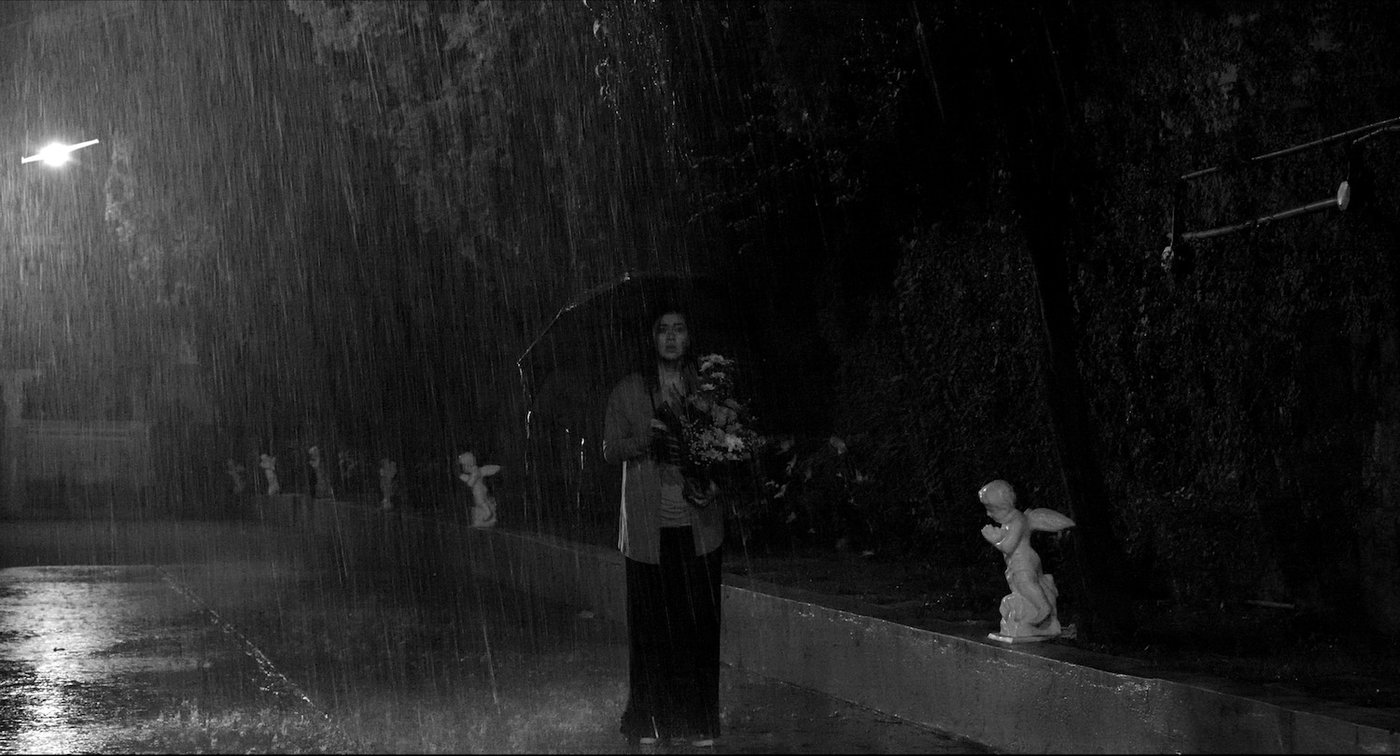
The filmmaker’s latest, The Halt, which premiered at the Directors’ Fortnight, is ostensibly science-fiction, being set in 2034. But except for the pervasiveness of drones that buzz around performing ID-checks and a subplot about a cyborg woman used as a prostitute, this film is quite clearly shot and set in the here and now. Its paucity of production resources, filmed in modest houses and city streets in grim darkness (in the fiction, a volcanic eruption has blanketed the entire country in shadow), gives its drama a caustic, unmissable immediacy. The filmmaker has never been so direct: in this “future” there is an egotistical, paranoid dictator who sends armed special forces and assassination squads to suppress and kill any form of resistance. Over its four-and-half-hour story, we see his anger, pettiness, and brutality alongside the way he uses the language of populism to paint himself a national hero and his enemies traitors. He rehabilitates and casts himself in the legacy of Marcos, and his regime is buffered by an all-female group of advisors that double as assassins. (It is they who are intertwined with the sex robot, as the film curiously paints these women all as lesbian.) Outside the government’s chambers—portrayed in the film’s characteristic lack of veneer or pretense simply as a fancy house—we follow a handsome young rebel flee from hiding place to safe house, gradually losing his hope for change; we see a priest tortured (“Fuck the president, fuck this country,” he laments in his last breaths); and watch a therapist who has written a subversive book about the missing history of the Philippines treat a young woman whose traumatic past has left her hollow, memoryless, and wandering. These citizens form the chorus of anxiety, desperation, and soul-searching that besets the population, while the president and his thugs are shown in comic parody.
Diaz’s films are famously long, a storytelling approach which allows for a proliferation of subplots, small characters expanded, bold digressions, abandoned incidents, multiple culminating threads, and long, winding journeys across geography and states of mind—all together taking advantage of narrative length to expand experiential power. Over its course, the emotion of The Halt is never less than bracing, its parody searingly grotesque, and its forlorn atmosphere genuinely distressing, but most of the film’s strands and anecdotes nevertheless are not as compelling as some of the stories contained in Diaz’s other recent films. Yet it is impossible to look away from such a direct missive of despair and yearning from inside one of today’s most appalling regimes. It is vital that such movies can be made and seen.
The Traitor
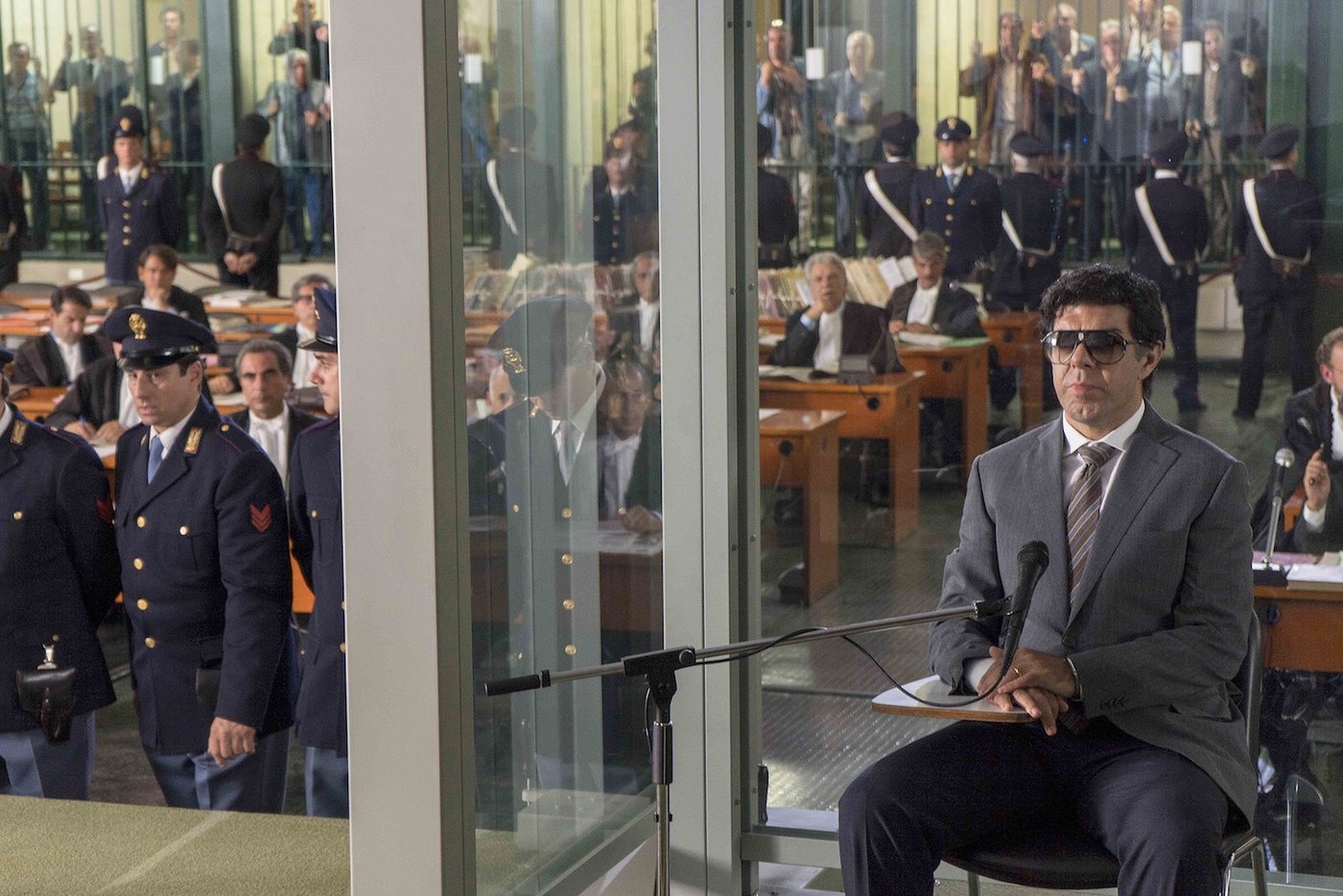
My last film of the festival was a period drama, but you might also consider it a subtle distress call to the present. Marco Bellocchio’s The Traitor goes an unusual route to tell the story of Tommaso Buscetta (Pierfrancesco Favino), the Cosa Nostra soldier who provided landmark testimony to the authorities in the 1980s Maxi Trial that publicly exposed the violence of his former “family,” as he calls them, and led to a bevy of convictions that crippled the Mafia. Rather than show us Buscetta’s rise to being an essential member of the Mafia and then cap this story with his betrayal of the world he was so a part of, Bellocchio opts to dramatize his life from betrayal onward. In fact, the film begins with him leaving a big Mafia party in Sicily and extracting himself to Brazil, tired of the new drug-oriented priorities of the organization. (One of his sons is implied to be a heroin addict.) Buscetta’s 1983 arrest and imprisonment in Brazil leads to his extradition and plea-bargain with the Italian government, and from there the film goes through his relationship with the prosecutor Judge Falcone, his public testimony in front of cameras and against his old capos and comrades, exile to America in witness protection, and a return to Italy to testify even more.
Throughout Buscetta’s path, Bellocchio removes the sexiness of both rags-to-riches crime sagas and general romanticization of Mafia lifestyle in favor of a story emphasizing the fortitude required in turning your back on the people that define your world when they transgress the boundaries of morality. Of course, the Mafia has always done horrible things, but from Buscetta’s point of view there is a moral and generational shift starting in the 1970s as entering the drug trade greatly increased profitability. In this view, drug profits irrevocably changed the culture of the mafia and destroyed older values, especially those related to who could be the target of violent crimes. This is certainly a rose-tinted view of the Cosa Nostra: that its traditional internal code of ethics, such as not killing women and children, was just. In a sly capper, the film pointed ends in a flashback that emphasizes Buscetta's bloodied hands, confirming if we ever needed it, that the man's sense of right and wrong is his own, and he hardly escapes culpability. Nevertheless, as different families were slaughtering each other in the early 1980s, including two of Buscetta’s own sons, a line was crossed for the man. And so the rest of his life becomes defined by this moral stance and radical severing of his past—after which he is pilloried by much of the public, vehemently hated by those whom he used to hold dear, and forever endangers his life and that of his family.
The Traitor is not interested in the specifics of Buscetta’s past or revelations, no doubt because these are well-known, not to mention done to death in countless movies. Rather, Bellocchio deftly narrates Buscetta’s journey of moral rectitude and personal vengeance by avoiding melodrama in favor of a muscular, straight-forward, style that cagily keeps the pentito's deeper beliefs or motivations off-screen. The film comes alive as the trials begin, and Bellocchio shifts registers to satiric but by no means inaccurate heights of comic frenzy in the confrontation between the stalwart Buscetta, cage after cage of enraged mafia defendants, and an exacerbated judge. The showroom staging, a glass booth around the witness, an arena of cages separating criminals, flanking magistrates, and bleacher seats of paparazzi, is magnificent and hugely entertaining. But it also underscores the impressive isolation of this witness and just how much of Italian society was against him. When Judge Falcone is later killed in Palermo, Bellocchio stages another bravura sequence: the bold highway car bombing, the celebration of the killing by Sicilians, and the tearful lamentations of the wife of a slain policeman at his memorial. But if anything this killing emboldens Buscetta’s vengeful desire to expose, and in the last trial portrayed in the film he tries to extend his takedown to the state government, including former prime minster Giulio Andreotti, who Buscetta claimed were conspiring with the Cosa Nostra.
It is this finale that brings to light the need for this story, Bellocchio’s interest in adapting it now, two decades after Buscetta’s death, and the film’s curious skimming over of expected juicy details and genre conventions. The story The Traitor tells is of a person whose betrayal for the sake of his personal sense of moral justice goes beyond whistleblowing the company that he worked for, but rather required the rejection of nearly his entire life and lifestyle up to that point, and indeed was essentially a self-imposed death sentence for himself and those few people who remain close to him. That this revolt moves from indicting the Mafia to trying to indict the corrupt state is an example of personal insurrection, albeit one motivated by a desire for revenge.
Earlier in the festival, we saw in Terrence Malick’s A Hidden Life the profound decision of a man to take himself out of the world he found evil. The Traitor goes a step further and exhibits a man who was willing to sacrifice himself in the hope that he could change that world. It is this kind of cataclysmic impact that Lav Diaz longs for in The Halt, and maybe one day will be able to portray.
Until that better day, it’s been wonderful covering Cannes with you, Leo. I look forward to what else you’ve discovered in the last days of the festivities.
Warmly,
Danny


from The Daily Notebook http://bit.ly/2K7g7um

Cannes Correspondences #12: Portraits of Artists on Fire

The Notebook is covering Cannes with an on-going correspondence between critic Leonardo Goi and editor Daniel Kasman.
Pain and Glory
Dear Danny,
Few things feel as sad as the end of a festival, and as I begin to look back at my first year in Cannes, crouched inside a bus that’s gliding past seaside towns, East-bound, the post-Croisette spleen fills the air with the memories of the past two weeks—sounds and images that feel almost unfairly beautiful now the Palais and the festival around it is miles past me already. And while it may still be too early to give in to rankings, of all the great many things I’ve been able to sit down and watch the past couple of weeks, there are two I trust will stay in me longer than any others, two spell-binding moviegoing experiences which, coincidentally, took place on my very last festival day—yesterday.
Three years after his last Cannes bow, Julieta, Pedro Almodóvar returned to the Croisette with his 21st feature and sixth Palme d’Or contender. Auto-fiction is nothing particularly new in the oeuvre of a man who’s devoted his four-decade-plus career to seesaw between truth and artifice, lacing melodramas with autobiographical details (his 2004 Bad Education possibly the most notable example of the trend). But nowhere has Almodóvar’s meta-fictional glance felt more personal, more inwardly-cast and affectionate than it does in his latest, Pain and Glory. A director who’s devoted much of his oeuvre to extend empathy toward countercultures and outcasts, to vindicate a stage where even the misfits could speak up and shine, Pain and Glory allows Almodóvar to carve one for himself. And the result is a profoundly elegiac work celebrating memory and filmmaking as two instruments that are both profoundly therapeutic and indissolubly bound together.
It is as entrancing and ethereal as the reveries of the man at its center, renowned Madrid-based director Salvador Mallo, a man at an emotional and creative standstill played with career-high bravado by one of Almodóvar’s oldest collaborators and muses, Antonio Banderas. Years have passed since the cineaste’s last film, and while the man is unmistakably aware that so much is at stake (“without filming my life is meaningless,” he bursts halfway through) there’s also a certain acceptance in the epiphany, a voluntary surrender. “But if you stop writing films, what will you do?” his assistant asks him, concerned. He shrugs. “Live, I suppose.”
Not that living comes any easier though. Stubbled and crowned with a silvery mop of spiked hair that only adds another layer of Almodóvarish similitude, Salvador suffers from virtually every ailment imaginable—from anxiety to migraines, from tinnitus to a paralyzing back pain. At sixty, he’s the empty shell of the cineaste who, thirty years prior, directed Sabor (Taste), a drama that helped consecrating Salvador as auteur, but also led him to a fallout with lead actor Alberto (Asier Exteandia), a man whose reckless heroine consumption went in the way of the director’s vision. A public screening of the early hit turns into an opportunity for a long overdue reconciliation. Alberto’s addiction hasn’t receded altogether—efforts to quit have been replaced by a dosage-control strategy—and if the unexpected sight of Salvador’s fatigued, pensive face visibly shocks the thespian, Alberto’s surprise isn’t a patch on the dumbfounded look he throws the director after Salvador suggests the two shoot heroin together.
Lulled by the drug, Salvador descends into a world of reveries and flashbacks that intersperse Pain and Glory like snippets from a movie running parallel to his own life (a feeling that thickens until a cathartic and revealing finale). They are the flickering relics of a childhood spent in poverty but lived with indomitable dignity, with preschooler Salvador (played by Asier Flores, a child with preternatural stage presence) trailing behind his mother (Almodóvar’s regular muse Penélope Cruz) as the family struggles to make ends meet while crammed in a cave-like dwelling. In a plot that unfolds as a series of vignettes of chance encounters, the beauty of Pain and Glory resides in its serendipity. To embark in Almodóvar/Salvador’s journey is to ricochet between memories and their random present-day resurfacing. Old lovers show up at the director’s doorstep; some others, older still, inhabit a world of flashbacks which Antxón Gómez’s production design and Paola Torres’ costumes bring back to life in a triumph of vivid palettes.
Pain and Glory is an act of recollection, and a painful one at that. The glory Almodóvar’s title alludes to is hashed out in the past tense, crystallized in Salvador’s gorgeous, art-crammed Madrid apartment (incidentally, Almodóvar’s own), a simulacrum of past triumphs now wrapped in darkness and silence. For this remains a story of suffering, one that dwells on the pain of artistic creation as it is experienced by those who struggle to reconnect to their past through art, and in the process, find some solace from a present marooned in desolating loneliness.
Portrait of a Lady on Fire
Almodóvar’s Pain and Glory celebrated its world premiere half way through the festival, along with another main competition entry, Céline Sciamma’s Portrait of a Lady on Fire. Screenings clashes and unsuccessful queueing meant I could only see both on the festival’s last, catch-up day. And it also meant that the pair arrived wrapped in its own week-old discourse and glowing praises, a buzz that was impossible to escape for two titles that were trumpeted by many to be serious Palme d’Or contenders (neither won, but each film took home a prize). Suffice to say that, if Almodóvar’s met all the expectations, Sciamma’s tale of shattering love surpassed anything I had braced for.
Set in a windswept stretch of coastline in 18th century Brittany, Sciamma’s Portrait zeroes in on Héloïse (Adèle Haenel), a blue-blooded twenty-something recently plucked out of a convent, and Marianne (Noémie Merlant), a woman of the same age who, unbeknownst to Héloïse, has been hired by the girl’s mother, a widowed Italian countess (Valeria Golino) to paint her portrait. Why on earth the ordeal would be kept secret from the intended recipient is something Sciamma parcels out gradually, as the mysteries around Héloïse grow thicker. Removed from convent after her sister suffered a fatal accident, the girl is heading toward the same fate her sibling was destined to: as a bride-to-be, her portrait is something her mother aims to carry to Milan to cajole an affluent prospective husband into marrying her daughter.
As Marianne and Héloïse become closer, the secrecy around the former’s job finally dispelled in a cathartic heart to heart where the two understand the rigid boundaries of the patriarchy they are up against, the portrait takes on an unbearably tragic dimension. The object that brings the two women together is also the one that will ultimately draw them apart, and there is nothing short of extraordinary in the way Marianne and Héloïse wake up to the realization, in a game of glances and gestures which, away from Héloïse’s mother’s stare, shift from furtive to wanting, as the young women’s relationship veers—and ultimately gives into—a tale of selfless love.
Much like another fulminating gem we had reported on a few days ago, Robert Eggers’ The Lighthouse, Portrait may well zero in on two characters, but there is nothing minimalistic about it. There is a whole life in every small gesture that brings the two girls closer, a whole cauldron of hopes and expectations in that terrified “do all lovers feel as though they’re inventing something?” Héloïse asks Marianne—the first lover she’s ever had. Gorgeously shot by Claire Mathon, alternating glacial daytime hues with a candlelit palette that don faces the sensual beauty of some Caravaggio paintings, and enriched by Dorothée Guiraud’s costumes, Portrait is a joy for the eyes. It is a film of quiet pleasures that percolates with the sadness of an inevitable goodbye—telegraphed from the opening shot, and still devastatingly powerful when it is finally conjured up.
And it is a film of conversations, a love story between two young women who come to know each other through long chats during windy strolls and painting sessions. And yet none of them, not even the deepest and most intellectually complex of the girl’s exchanges, feels excessively abstract. At the heart of Sciamma’s shattering love story is the myth of Orpheus and Eurydice, and in a pivotal juncture, the girls sit by the fireplace to discuss the reasons that brought the Greek god to turn back to his beloved as she reemerged from Hades, knowing all too well that doing so would make her vanish forever. Watching Haenel turn her face toward the camera after a frantic run to the cliffs, the first time her luminous face graces the screen in a fourth-wall rupture of enthralling magic, the myth rang achingly close to Sciamma’s own tale. That flickering split-second her eyes met the audience, and an entire Debussy theatre held its breath to take it all in—the run, Haenel’s face, her stiff smile, the resonance of that frantic sprint toward the cliffs and the way her run stopped right before the abyss—was very possibly the single most striking sequence I will remember from my time in Cannes this year.
More from me again very soon,
Leo


from The Daily Notebook http://bit.ly/2QpQ7LT

Sunday, 26 May 2019

Cannes 2019. Awards

Bong Joon-Ho's Parasite
IN COMPETITION
Palme d'Or: Parasite directed by Bong Joon-Ho (read our review)
Grand Prix: Atlantics directed by Mati Diop (read our review)
Jury Prize: Les Misérables directed by Ladj Ly (read our review)
Best Director: Jean-Pierre and Luc Dardenne for Young Ahmed
Best Actress: Emily Beecham for Little Joe (read our review)
Special Mention: It Must Be Heaven directed by Elia Suleiman
UN CERTAIN REGARD
Prix d'interpretation: Chiara Mastroianni for On a Magical Night
Prix de la mise en scène: Kantemir Balagov for Beanpole (read our review)
Jury Prize: Fire Will Come directed by Oliver Laxe
Un Certain Regard "Coup de Coeur" Award: The Climb by Michel Covino
Special Jury Prize: Liberté directed by Albert Serra (read our review)
Jury Special Mention: Jeanne directed by Bruno Dumont (read our review)
CAMERA D'OR
CINÉFONDATION
Special Mention: Monstruo Dios directed by Agustina San Martín
CRITICS' WEEK
Nespresso Grand Prize: I Lost My Body by Jérémy Clapin
DIRECTORS FORTNIGHT
Europa Cinemas Label Award: Alice and the Mayor by Nicolas Pariser
FIPRESCI: COMPETITION
FIPRESCI: UN CERTAIN REGARD
Beanpole directed by Kantemir Balagov (read our review)
FIPRESCI: DIRECTORS FORTNIGHT or CRITICS' WEEK
The Lighthouse directed by Robert Eggers (read our review)
PRIZE OF THE ECUMENICAL JURY
A Hidden Life directed by Terrence Malick (read our review)


from The Daily Notebook http://bit.ly/2Esiaph

Cannes Correspondences #11: Vulgar Confessions

The Notebook is covering Cannes with an on-going correspondence between critic Leonardo Goi and editor Daniel Kasman.Liberte
Liberté
Dear Leo,
The festival may almost be over, but that doesn’t mean the chance for controversy is gone. Abdellatif Kechiche’s new film, Mektoub, My Love: Intermezzo, premiered at the end of Cannes because it literally was finished this very month, but one might also suppose the festival preferred this presentation, enlivening the rapidly depopulating Croisette with scandal. I haven’t seen it yet, and in fact only caught up with the first Mektoub (subtitled Canto Uno) two weeks ago. Despite its 2017 premiere in competition at the Venice, it was never shown in North American film festivals and still has not been distributed. There is good reason for this shunning, even though the first film is Kechiche’s follow-up to the Palme d’Or-winning Blue Is the Warmest Color: it was brazenly and unredeemably misogynistic, leering at every possible moment at the bodies of its actresses for its over-three-hour runtime, and giving these women almost no agency in its story. (I also found it interminably monotonous and boring, but that isn’t in the same category as moral judgment.) That there is another three-plus-hour sequel to this piece of garbage isn’t surprising, since it is formed out of footage shot during the original production (and there is presumably a third film to come); that it has been programmed in competition in Cannes at all, and especially at this moment of heightened political sensitivity in the culture, seems either purely tasteless or intentional trolling.
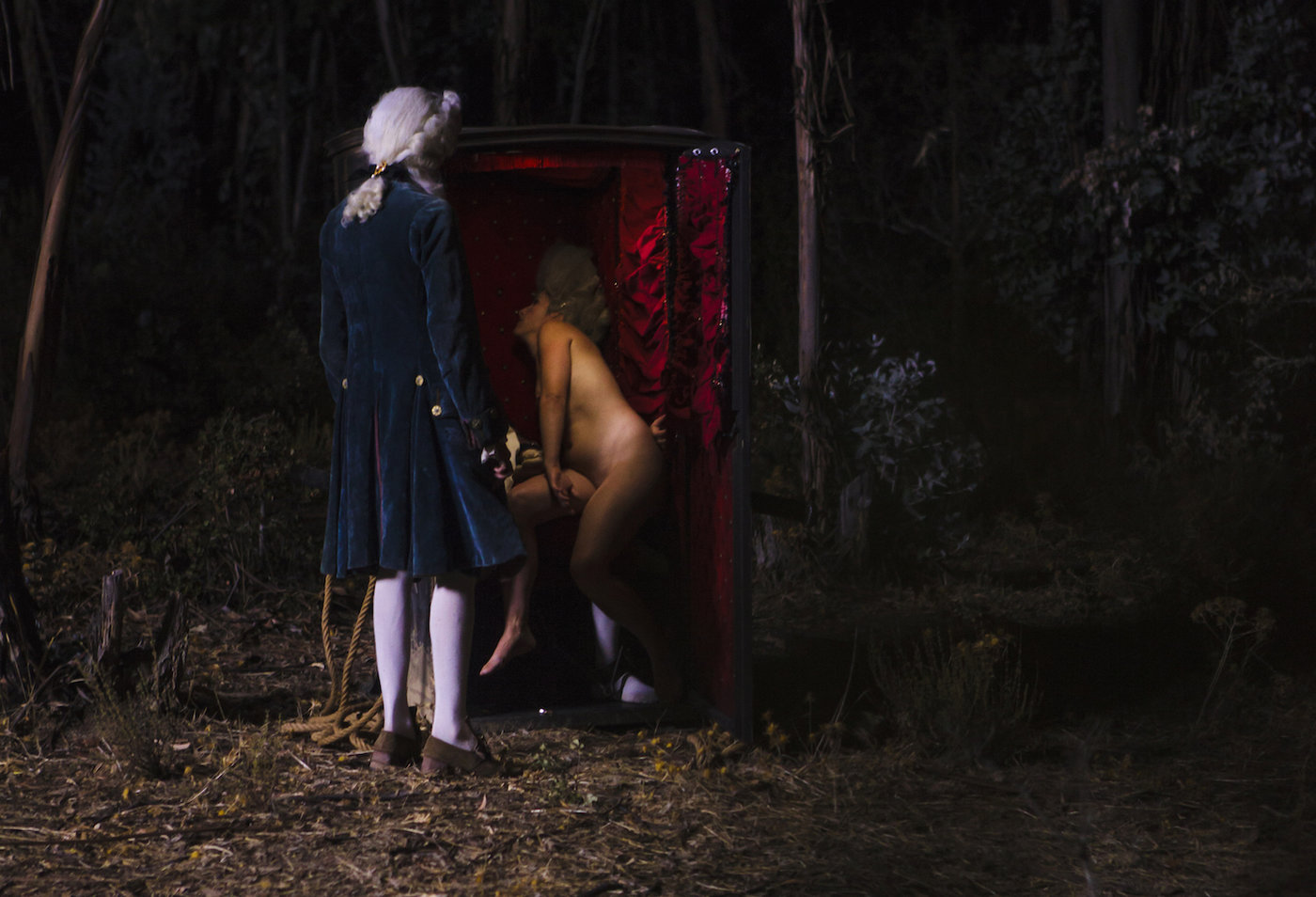
But as I said, I haven’t seen it—perhaps you can tell me more tomorrow. What I have seen was what many thought the most controversial film at Cannes this year up until the Mektoub premiere: Liberté. Its vulgarity carries the smack of calculated transgression because it is directed by Albert Serra, whose bold emphasis on stripping down his famous subjects—Quixote, the Magi, Casanova, Louis XIV— to exhibitionist essentials of the all-too-human body, unexpected proclamations and utterances, and opulent yet spartan period trappings, all caught in the stultifying, anti-glamorous passing of time, has allowed the Catalan provocateur to move with ease between the film and art worlds. This new feature emerges out of both a two-screen installation as well as a play staged at the Volksbühne Berlin. Its affinity for all these media is immediately clear: taking place on the cusp of the French Revolution in an isolated European forest upon which night rapidly falls, we watch various tableaux of aristocrats and their servants effectively cruising for sexual stimulation or voyeurism in a languorous, story-free procession of isolated actions inside sedan chairs and out in nature. The context for this is set up in a long monologue relating the slow dismemberment of man who tried to assassinate Louis XVI and the pleasure of the crowd in watching him be so grotesquely killed. The entourage of libertines we will watch fiddle with and gawp at each other over the next two hours or so have escaped the disapproving atmosphere of the court and the times. While almost all other subsequent dialog is about erotic fantasies or demands for more whipping or other sexual acts, this opening vitally places what follows in a world politically and socially turning upside down, emphasizes the decadence that absorbs the elite of the era, extends that decadence to suggest the possibility of a libertine social utopia, and intertwines the desire for sex with the desire for death. It also ultimately shows that the rich are just like everyone else, bodies partially (sometimes mostly) defined by sexual needs.
While the premise of the film is theoretical and abstract, what follows throughout this chilled out viewing experience is very simple: immersing us in indolent atmosphere of fetid sexuality, evoked through Serra’s typically beautiful and unique quality of digital photography, here mottled in dark shadows and the knubbily textures of foliage and 18th century embroidery. Mostly men (mostly elderly, mostly ugly) touch themselves over their clothing or watching others do it, and some women (all young and beautiful, as well as more exposed) are fondled, licked, and whipped in a slow escalation to more extreme acts that makes up the film’s only sense of narrative movement or time passing. For the first half of the film you might be surprised by Serra’s discretion, considering that these “poisonous woods,” as one aristocrat calls them, are rife with pent-up sexual needs. But fulfillment doesn’t come quickly: no intercourse nor any nudity occurs for a surprising amount of time, just the repetition of idle stimulation and the movement from watching (or performing) one action to another. But eventually we see more, much more: a graphic rimming, emphasis on the damaged face and body of a physically disfigured man, what looks like a real whipping of a woman’s naked bottom, people urinating on one another. By this time the film’s desolate and self-involved sex practice is clearly evoking Pasolini’s Salò, yet it still skirts greater explicitness. As strange as it is to say, there is something bizarrely demure about the film’s lack of on-screen penetration. Most penises seen are in fact limp, and gradually it becomes clear that Liberté isn’t aiming for a staging the world’s most drawn-out orgy in the woods, but rather an experience much more tentative and perhaps even impotent.
At a certain point, all this languor and the constant repetition of similar actions and similar gazes stopped giving me new things to see or think about, and for a while I was entranced in a vaguely hypnotic way by the oneiric and timeless atmosphere, the nocturnal soundscape, the odd, almost pathetic lack of energy in these sexual dilettantes. But this too wore itself out, and the film starts to grow increasingly exasperating and tedious. The post-1990s trends of extreme minimalism in art-cinema often has a problem of distinguishing the difference between a subject and form slender enough for a short film and one robust enough for a feature film, and this is a problem that besets Liberté. Despite its vulgarity, the film never feels as audacious or daring as I sense Serra thinks it is, but the festival context alters this impression quite a bit. In both style and content, Liberté’s tableaux vivant is almost certainly the most avant-garde film to be shown in the Un Certain Regard section, if not the Cannes Film Festival as a whole, and it is admirable indeed that the they would program such an flagrantly challenging and narrativeless picture for such a crowd. But then again, let’s be honest: this is Cannes during the film festival—probably some members of the crowd were planning on leaving the premiere for a night of similar bacchanalia in their hotels, villas, and yachts. Maybe what we were really looking at was not a poisoned forest but rather a poisoned mirror.
A mirror is also one way of thinking about the movie Tommaso, in that it is a work of unusually personal autoficition by its director, Abel Ferrara. Shooting in his own flat in Rome, to which the great but underfunded New York director decamped many years ago, casting his wife and their young daughter to play themselves, and having Willem Dafoe act as his stand-in sharing personal details—including being a recovering addict and working on the long-gestating film project Siberia—the film finds the universal in the confessional. Shot guerrilla-style with the most minimal budget possible—Werner Herzog’s cinematographer, Peter Zeitlinger, ensures a raw and immediate look—the film offers vivid flashes of the energetic but conflicted life of the titular director as he swings from joy with his four-year-old daughter to flashes of anger over his young wife’s self-sufficiency, the strength granted by confessions at AA meetings to constant erotic dreams of other women.
Like Ferrara’s wonderful biopic Pasolini—only recently released in the States after its premiere five years ago—which also stars Dafoe as a director, the film shows a life that struggles to balance the fantastic possibilities of filmmaking with the day-to-day mania involved in living a fulfilled family and creative life. We see storyboards of Siberia as a well as imagined scenes that could be for another desired film project, adapted from Mikhail Bulgakov's The Master and Margarita, which Tommaso projects himself into this drama as a man suffering a Christ-like passion. He also unreasonably suffers in his fresh marriage, and several of the arguments between the husband picks with his wife are very parochial indeed, but this serves as a more self-lacerating portrait—and after all, Ferrara has always embraced the vivacity of pulp and exaggeration. Throughout, Dafoe gives it his all in a movie that revolves the world around this ultimately very average man. With its extreme modesty of scale, intimate subject matter, and emphasis on poetics over storytelling, Tommaso is in keeping not so much with American cinema as it is in old-guard European auteur cinema in which visionaries have been reduced in funding to making bedroom productions, like the last two films by Jean-Claude Brisseau and Jean-Luc Godard. It might be a sketch of a film in between larger paintings, but there is always something more revealing and for that reason more expressive about an artist’s smaller, looser work. It is remarkable and not a little touching that Ferrara so wishes to share the torments and pleasures of his daily life he has found while striving to create greater things.
Warmly,
Danny


from The Daily Notebook http://bit.ly/2VONcgH

Cannes Correspondences #10: Friendly Kisses and Inseparable Sisters

The Notebook is covering Cannes with an on-going correspondence between critic Leonardo Goi and editor Daniel Kasman.
Matthias & Maxime
Dear Danny, 
How nice it was to read your glowing words on Bong Joon-ho’s Palme d’Or contender. His Parasite belongs, together with a handful of other main competition entries, to a list of Cannes titles I shall be catching up on Saturday, when the festival will run a few repeat screenings ahead of the awards ceremony. With a program as rich and tantalizing as this year’s, it’s virtually impossible not to let a few titles slip past you. And while I may have postponed my rendezvous with the likes of Céline Sciamma, Pedro Almodóvar, and Bong Joon-ho, I did make sure to catch the homecoming of one of Cannes’ youngest regulars, Xavier Dolan.
Ever since his 2009 debut feature I Killed My Mother, which found a spot at the 2009 Directors’ Fortnight, the Canadian’s career has unspooled as a series of almost uninterrupted Croisette bows. His following two features, the Heartbeats (2010) and Lawrence Anyways (2012), earned slots in the Un Certain Regard sidebar; after the 2013 Venice-premiered Tom at the Farm, 2014 marked his graduation to Cannes' main competition, with Jury Prize winner Mommy followed by It’s Only The End of The World, which received the 2016 Grand Jury Prize as well as a mauling from critics, the less than tepid response leading the then-27-year-old to vent at the festival’s “culture of hatred.” Whether or not the criticism was the reason that led his 2018 The Death and Life of John F. Donovan to seek other pastures, eventually premiering in Toronto, that Kit Harington-starring excursion into the power of celebrity fared more poorly still, universally received as the Canadian auteur’s biggest misfire to date. After a couple of less than underwhelming additions to his oeuvre, Dolan was in desperate need of a return to form. And as someone who owes him a great deal of emotional wreckage for his earliest titles, Lawrence Anyways and Mommy especially, it saddens me to report Matthias & Maxime didn’t really strike as one. 
To be sure, a return Dolan’s Palme d’Or contender is: after the English-speaking, London-set Donovan, Matthias & Maxime brings the action back to the Canadian’s native Quebecois turf. A gorgeous lakeside chalet is home to a handful of twenty-somethings’ weekend retreat. Entry-point into the gathering is the eponymous pair. Matthias (Gabriel D’Almedia Freitas) and Max (played by Dolan himself, here in a writer-director-actor triple duty he hadn’t pulled since Tom at the Farm) have been friends since childhood, but brace for a looming farewell, as Max is a few months’ away from a semi-permanent move to Melbourne. It’s a rupture that takes on the magnitude of a break-up. For the two, never mind whether they never refer to themselves as such in the confines of their heteronormative world, do act and look like a couple. The chemistry enveloping Matthias and Maxime ventures beyond best-friendship terrain long before the pair agrees to star in a short film directed by party host Erika (Camille Felton), a scene that has them make out before the camera (and which Dolan curiously cuts). It’s not the first time they’ve kissed, reveal the other guests—and indeed, Dolan’s script subtly hints at the extent to which the two may have self-consciously internalized their union. “Doesn’t she know we hate her?” they ask of Erika on their way to the chalet, that “we” hinting at a liaison of deep, mysterious roots. 
But the onscreen kiss brings the friendship to a halt. As an ellipsis rockets us to twelve days before Max’s departure, the two have grown apart, and Matthias & Maxime adjusts to the withered relationship conjuring up two separate portraits, and turning into a study of contrasts. This gives Dolan, via Maxime, the chance to return to some of the social commentary he’d articulated in Mommy. Contrary to Matthias, a brilliant young lawyer on his way to a promotion and a “two-window office view” his firm’s boss promises, a young man who’s unmistakably been raised in privilege—Maxime hails from the opposite side of the socio-economic spectrum. Raised by abusive, ex-addict, and chain-smoking mother Manon (Anne Dorval, of titular Mommy fame), brother to an estranged young man of whom nobody has heard from in ages, it’s easy to read Max’s intercontinental trip as an escape from a lugubrious family situation (part of the pre-trip arrangements includes figuring out how to convince his mother, clearly unfit to manage her own money, to accept her own sister as guardian). 
But Matthias & Maxime isn’t a patch on Mommy. Where Dolan’s 2014 Jury Prize winner had crafted a piercing and engrossing mother-son relationship, the dynamic between Maxime and Manon is far more tenuous, partly because—much like every other character outside the titular duo—hers too gets mired in an unnervingly caricatural aura. And while Dorval strikes as a far tamer, and far less complex version of her own predecessor in the 2014 film, there’s something cringeworthy in watching Erika turn into the naive archetype of a pretentious, vacuous Franglish-speaking film student, introducing her short as a blend “between expressionism and impressionism” (whatever that may mean); something stomach-churning in her cartoonishly loud and gossipy well-to-do mother, who rushes to praise the daughter’s effort for being “like Elmodóvar” (sic). At best vaguely sketched—and at worst, reduced to a collection of stereotypes—the loud panoply of secondary characters surrounding the eponymous two only detracts tension from the plot. 
And indeed, unlike the raw energy that had imbued the best among Dolan’s earlier works, there are moments when Matthias & Maxime strikes as unnervingly flat. For a film anchored on two ostensibly heterosexual friends waking up to the realization that their friendship comes with an expiration date—and that said friendship may be venturing beyond the contours of strictly platonic affection—there just isn’t much grit under all the theatrics. It’s a feeling of emotional emptiness that finds an echo in André Turpin’s handheld 35mm camerawork, zooming in and out of dinner table conversations and alcohol-induced confessionals, as if to frantically look for, and striving to accentuate, an already feeble drama. To be sure, Matthias & Maxime is a much-welcomed departure from the exhaustingly hysterical exchanges of It’s Only the End of the World. And a couple of heated altercations between Matthias and Maxime, and between Matthias and old-time pals, offer some of the most inspired moments here, where tension between the eponymous friends is tangible, their relationship negotiated, shattered, and rescued in the public realm of weekend getaways and parties. But even those scenes have the feeling of insular units, chunks of a large construction that never truly comes into a whole. And this explains the somewhat disappointing state Matthias & Maxime left me in: the feeling of having watched a film that thrives in the grinding of two characters fumbling after an identity, but once the grinding is over and the sparks that result from it fade away, little emotional resonance remains. 
The Invisible Life of Euridice Gusmão
Matthias and Maxime’s friendship-bending kiss, and the identity crisis it plunged both young men into, took place against the backdrop of a strictly heteronormative world. A couple of days before Dolan’s Official Competition entry, I was able to catch another work that homed in on a relationship blossoming within—and constrained by—a patriarchal universe, Karim Aïnouz’s The Invisible Life of Euridice Gusmão. Premiering in the Un Certain Regard sidebar, where Aïnouz’s feature debut Madame Satã had shown in 2002, The Invisible Life of Euridice Gusmão is a beguilingly singular title for what is quintessentially a siblings’ tale, one of two inseparable sisters forced to fight against a calcified and all-pervasive patriarchy. Based on a 2015 novel by Martha Batalha (and written by Murilo Hauser, Ines Bortagaray, and Aïnouz), it follows two young women in 1950s Rio de Janeiro, the eponymous 18-year-old Euridice (Carol Duarte) and 20-year-old Guida (Julia Stockler). Raised in a conservative household by father Manuel (Antonio Fonseca) and submissive mother Ana (Flavia Gusmao), the two struggle to find a voice and space beyond the limited roles a male-dominated society has pigeonholed them into. 
Preternaturally talented pianist Euridice dreams of landing a spot at Vienna’s music conservatory, while her more confident, volcanic older sister dances her nights away in the company of her boyfriend, Greek sailor Yorgos (Nikolas Antunes). In a lush, rainforest-set preamble, The Invisible Life had opened with the two sisters losing each other on their way home. It’s a separation that foreshadows Guida’s decision to abandon Euridice and parents overnight, eloping with her sailor across the Atlantic only to return to Rio pregnant and alone. But no begging can persuade her father to take her back. Her transatlantic escapade and unwanted pregnancy may irreparably compromise the family’s honor, and as both parents unceremoniously throw “ungrateful daughter and bastard grandson” back on the street, they resolve neither daughter should know of the other’s existence, telling Guida that Euridice left to pursue her pianist career in Vienna, and never once delivering the letters she will write Euridice and ask them to forward to her sister. 
Aïnouz may not bear the same household name of fellow Cannes attendee and melodrama-savvy auteur Pedro Almodóvar, but The Invisible Life offers outstanding evidence of the Brazilian’s ability to play with the genre’s tropes and craft a wrenching tale of sliding doors, of lives unfolding along parallel lines and almost—but never quite—crossing. And that his latest period piece (however languid the leisurely 139-minute length may sometimes feel) still engulfs one in a tearjerking finale is courtesy of a script that blends ample doses of melancholia with a piercing dissection of patriarchy at its most execrable lows. Integral to the excursion is Aïnouz’s portrayal of sex. Shipped back to Rio and scavenging for cheap accommodation across the city’s lower-income neighborhoods, the few times single mother Guida allows herself to indulge in some casual fun carry a sad, mechanical aftertaste, the feeling of something performed as a loveless, passionless routine. And there’s a sad ring to the heart-to-heart she has with her best friend-cum-housemate Filomena (Barbara Santos): “I’m tired of being someone else’s fun.” 
But it is in Euridice’s own body that sex comes close to embody an instrument of power, a belittling and humiliating mechanism akin to institutionalized rape. In what is possibly The Invisible Life’s most revolting scene, newlywed Antenore and Euridice consummate their marriage. It’s a sex scene that starts off as incredibly clumsy and gradually takes on a far more disgusting, almost predatory dimension, setting the tone for the future sexual encounters Antenore will effectively demand from his wife. And it’s a far cry from the wide-eyed stupor and inquisitive glances Euridice had darted at her sister, when, in that idyllic if long-gone era they spent under the same roof, Guida would tell her of her experiences with Yorgos, and the two girls who confide in each other—sex still some mysterious and ethereal notion lingering above them.
At its best, The Invisible Life crafts a timeless elegy of resistance, which speaks to the time and place it’s set in just as loudly as it does to present-day Brazil, a country which, as Aïnouz reminded the Debussy theatre, introducing his feature, “is the country with the biggest number of single mothers and crimes against women.” It is a story that unfolds as a correspondence, as Guida will continue to write never-delivered letters to her sister through the years, and the two women will move on with their lives, looking for each other and finding refuge in the solace of old reveries, billowing to life with Benedikt Schiefer’s score—interspersed with piano pieces by Chopin, Grieg, and Liszt—and in the vivid, warm colors of Hélène Louvart’s cinematography. It’s a dreamlike world of contagious beauty and nostalgia. By the time an ellipsis takes us several decades forward, and a now-octogenarian Euridice resumes her quest for her beloved sister, The Invisible Life has wrapped you in that curious and ineffable feeling you experience when you realize you haven’t just watched two characters grow onscreen, but have grown with them, too.
Until the next dispatch, 
Leo


from The Daily Notebook http://bit.ly/2HQSymP

Thursday, 23 May 2019

Cannes Correspondences #9: Burning Witches and Invasive Parasites

The Notebook is covering Cannes with an on-going correspondence between critic Leonardo Goi and editor Daniel Kasman.
Lux Æterna
Dear Leo,
I’m quite a bit more ambivalent about Quentin Tarantino’s Once Upon a Time...in Hollywood than you. Its violent climactic revision of 1969 Hollywood history seems like a much thinner, cheaper, and as you (positively) indicate, more nostalgic version of the ballsy visions of finishing off Nazi Germany and slavery in Inglourious Basterds and Django Unchained. I’m still thinking my way through this culmination, and especially how as a concept I’m quite suspicious, yet I couldn’t help but find the ending (of a Tarantino movie!) very touching.
Last minute additions to the Cannes lineup are de rigueur at this festival, which not only announces films finished in the nick of time (this year, the Tarantino and Kechiche, last year Ayka, and the year before Lynne Ramsay’s You Were Never Really Here), but also add the spice of unpredictability to the final days before the festival. Among this year’s late entries was the announcement that Gaspar Noé had a new film, Lux Æterna—but of the odd length of 50 minutes and shown at midnight. It proved a welcome dose of mad flourish and unexpectedly found itself in dialog with two other films of experiential spirituality, Jeanne and A Hidden Life. That it was commissioned by Saint Laurent explains a lot (Luca Guadagnino is at the Directors’ Fortnight for similar reasons, with a 35-minute film commissioned by Valentino), but never gets in the way of Noé’s three-part story of a chaotic film shoot that, as it falls apart, achieves the sublime. In fact, the length is to the film’s benefit, for Lux Æterna’s middle section, which follows multiple characters around the harried set of a witch-themed film directed by Béatrice Dalle and starring Charlotte Gainsbourg (both playing themselves), is as purposely hellish and aggravating to watch as much of Noé’s last film, Climax. Split screens, multiple camera views of the same action, and maze-like wandering around the set dynamize this behind-the-scenes view but hardly add much new: Portraying a film set as bitchy, busy, a logistical muddle, and full of doubt, anger, opportunists, sycophants, and double-crossing got stale several decades ago. However, it’s the book-ends to this centerpiece that provide the film’s content (first) and powerhouse climax (finale). Lux Æterna’s prologue quotes Dreyer on making movies into art—later quotes by Godard, Fassbinder, and Buñuel punctuate throughout with self-reflexively portentous title cards—and we see scene of the old woman being dropped into the flames in Day of Wrath, followed by a comment about the actress suffering on set before her character is killed. This sets the stage for a modern day evocation of witchcraft, female suffering and martyrdom, and since the film forgoes an epilepsy warning with a quote from Dostoevsky about the ecstasy experienced before a fit, we can anticipate a full-body evocation.
At the film’s opening, Dalle and Gainsborough recline on leather chairs on the film set, idly chatting about acting, playing witches, sleazy producers, rarely dating good men, and awkward sex scenes. This is shown in simultaneous split-screen from different angles isolating each actress, a simple but effective evocation of simultaneity and commiseration hand-in-hand with isolation. Dalle does most of the talking and sets the stage for topics of bodily sacrifice, humiliation, and the sexy and classy (her words) on-screen death of being burnt at the stake. This becomes relevant as the day’s shoot finally gets underway filming what clearly looks like a terrible idea for a scene—or is it an ad shoot for Saint Laurent?—of three skinny models in skimpy, tacky cocktail dresses tied to stakes in front of a giant LED screen showing smoldering flames. But as Gainsbourg takes her place at the stake, and just as frustration sets in at all the backstage shenanigans, the grating, forced hysteria of the turmoil of making a film, Noe cuts all the bullshit. And cuts the lights too—and then cues the strobe lights. The climactic finale, eye-bleeding and eardrum bursting, is a multi-color, multi-screen stroboscopic incineration of the film shoot (which shuts down amid the cacophony), of Dalle (who writhes in ecstatic turmoil), and above all of Gainsbourgh on the stake, following in the path of Falconetti, Bergman, and Florence Carrez.
The immolation makes a brazen but by no means irresponsible conclusion: That actresses go through hell to create art, that artists surviving in the inferno of commercial imperatives are suffering saints, that misogyny lives on in new forms, and that those who give their body and soul to the light of the silver screen deserve to be honored if not worshipped for their sacrifice for us. Amen. The film ends with a quote from Buñuel, “thank god I’m an atheist,” which one might take as a cynical inclusion by Noé except that what is left implicit is that while great surrealist may not believe in God, he does believe in the cinema.
Parasite
Parasite
Lux Æterna is a film of bravura: the boldness of its conception, and the length it will go to achieve it in aggressive vulgarity. Parasite, by contrast, is a film of virtuosity: Bong Joon-ho directs each scene, sequence, and the film itself with a precision, dexterity, and effectiveness as if it’s the easiest thing in the world. It is not. I wrote in my festival introduction lamenting where a filmmaker like John Carpenter could be found at Cannes in this day and age, and lo and behold, Bong has not just raised his hand but leapt up eager to prove himself one of the master storytellers of popular cinema. Parasite is thrilling in its deft ingenuity and razor sharp in its critique, the perfect buffer in Cannes’ competition against more strained examples of art and prestige cinema. 
As if created as a response to two films last year, Lee Chang-dong’s Burning, with its stark contrast between the new rich and poor in South Korea, and Hirokazu Kore-eda’s Shoplifters, with its downtrodden family willing to do bad things to survive a life in the shadow of society, Parasite funnels the outrage of class disparity into a swift, blackly comic story of a poor family ingratiating and integrating itself into the lives of their rich doubles by any means necessary. Introduced living in a half-basement outside which men constantly vomit and piss, the florid parents of the family (Song Kang-ho, a long-time Bong lead, and Chang Hyae-jin) are unemployed and their wily children (Choi Woo-shik and Park So-dam) haven’t completed college. A chance provided by a friend moving abroad gives the son an opportunity to bluff his way into tutoring the daughter of an elite family. This family is a mirror for their own—svelte father (Lee Sun-kyun, from Hong Sang-soo’s Oki’s Movie and Our Sunhi), elegant helicopter mother (Cho Yo-jeong), teenage daughter (Jung Ziso), and young son (Jung Hyeon-jun)—and lives in an architectural marvel of a house, all open floor plan, top to bottom windows, wood floors, glossy everything, and a castle-like wall surrounding the garden. From his new position, the son contrives to get his sister hired as an art tutor for the family’s youngest, and it’s only a matter of time before the household’s existing staff is comically but ruthlessly replaced by their parents. But if they can so easily take over the positions of others—the film here echoing Werner Herzog’s Family Romance LLC. in people's reliance on roleplaying in everyday life—this also means their newly achieved status at the top of the bottom is just as perilous: As they are now, others were before, and indeed others may be after as well. 
Like Carpenter, Brian De Palma, and to a degree, Steven Spielberg, Bong Joon-ho is a filmmaker who uses storyboards to calibrate his storytelling to not for the sake of pretty pictures and antiseptic predetermination, but rather to orchestrate action and suspense for maximum speed, rhythm, and impact. His frames are alive with activity and spatial detail, not just fleshing out the mise en scène of his world, but teasing and elucidating space to move us from action to action, idea to idea, frequently playing with what we know or don’t know such that the film, however grim in behavior, is constantly surprising and comic. In particular, the film has a field day with the modernist mansion in which much of the story hijinks occur, a playground of spaces to navigate in different ways: run, hide, fight, play, inside, outside, upstairs, down, the basement and the depths, much with a view of the pristine garden.
Parasite’s centering on this house, a world unto itself, is reminiscent of Snowpiercer's allegorical train, but this new film avoids the unevenness that plagued that film and Bong's even more ambitious follow-up, Okja. The more constrained setting and concept transforms Parasite into a kind of Gothic farce, updating a drafty chateau or creaky Victorian mansion to the pinnacle of contemporary Korean prosperity, and haunting it from within by invaders masquerading as servants. Or are they simply servants? “This is very metaphorical,” the tutor wryly remarks at more than one point. He alone idly daydreams of marrying his rich student and officially joining her family, but financial gain does not seem his family’s plan: They are simply and ruthlessly focused on achieving and maintaining their place in the mansion. Thus the film isn’t about class mobility but rather about fighting—in this film, first with brazen callousness and lack of empathy, and eventually violently and bloodily—to be top servant. To go beyond class barriers is also beyond the range of most imaginations. This is a brutally cynical view, and you shouldn’t expect psychological insight or even judgment for any character, rich or poor, for Parasite is a vivid work of behaviorist cinema, seeing what people do under specific circumstances in a specific environment. Not unlike Ken Loach's Sorry We Missed You, it portrays the inexorability of a system where those at the bottom thrash in death throes to maintain their position there. As its ghastly flourishes mount to Grand Guignol heights, the cut-throat desperation of our poor heroes gets more and more dissonant and horrific. But Bong’s filmmaking keeps firing on all cylinders, and from top to bottom Parasite gleefully and with dextrous cleverness balances on the line between the horrid and hilarious.
Though we still have several more premieres to go, I have little doubt, Leo, that Parasite is the best film in the Cannes Film Festival's main competition.
Warmly,
Danny


from The Daily Notebook http://bit.ly/2JylVh3

Rushes: Cannes Clips, Mati Diop, Crafting Cinematography

Get in touch to send in cinephile news and discoveries. For daily updates follow us @NotebookMUBI.
NEWS
The late Machiko Kyo in Cannes, c. 1960.
RECOMMENDED VIEWING
  • The 2nd trailer for Quentin Tarantino's Once Upon A Time In Hollywood, which expands further upon the film's storytelling ambitions, comic tone, and inspired casting.
  • Janus Films has released the trailer for its new restoration of Paris is Burning, Jennie Livingston's seminal 1990 documentary on New York City drag ball culture.
 
  • Ahead of its June 21 release, the final trailer for Toy Story 4 promises road trip adventures and, as per usual, some existential mayhem regarding what it means to be a child's toy.
  • Exclusive clips by way of Cannes, each depicting intimate encounters. Abel Ferrara's Tommaso follows an American artist and his young wife and daughter in Rome; Terrence Malick's A Hidden Life tells the story of an Austrian soldier who refuses to fight for Nazi Germany. Read editor Daniel Kasman's review of A Hidden Life here.
RECOMMENDED READING
French director Mati Diop at her Cannes photo call.
  • French filmmaker Mati Diop is the first black woman filmmaker to compete at Cannes with her debut feature Atlantic. In an interview with the New York Times, Diop details the genesis of her Senegal-set project, which reckons with neocolonialism and migration as inspired by Penelope, the wife of Odysseus.
  • Indiewire has compiled a survey of the cinematographers for the 54 feature films premiering at Cannes detailing the cameras and lenses they chose for their films and why.
  • Sheila O'Malley examines the relationship between Sigourney Weaver's Ripley and Michael Biehn's Corporal Hicks in James Cameron's Aliens, which exists among "the continuum of tough guys and tough dames, who come together against the societal odds, to meet on equal terms."
The set of Rumble Fish (1983).
  • American Cinematographer has revived an integral article from their archives: director of photography Stephen H. Burum, on the verge of shooting Brian De Palma's Body Double, reflects on the many aesthetic ambitions undertaken while shooting Francis Ford Coppola's Rumble Fish.
  • Over at Vulture Anjelica Jade boldly argues for Star Trek: Deep Space 9's place in the black TV and science fiction canon, and more largely, the mainstream inclusivity of the African-American experience.
RECOMMENDED LISTENING
Joji Koyama & Tujiko Noriko's Kuro.
  • The dreamy soundtrack for Joji Koyama and Tujiko Noriko's Kuro, which we previously showed on MUBI in summer of 2018, is now available on various streaming services, including Spotify and Apple Music.
  • Ahead of a rare screening of the original Cannes premiered cut of Southland Tales, director Richard Kelly discusses his misunderstood apocalyptic epic and its differences between the films two versions.
RECENTLY ON THE NOTEBOOK
  • The posthumous release of Raúl Ruiz’s The Wandering Soap Opera, made in a student workshop, reveals Ruiz's involvement in teaching and its enablement of a freer creative process.
  • In an interview with Beatrice Loayza, Joanna Hogg discusses her latest The Souvenir, exclusive spaces, and the influence of stratification on human behavior.
  • Our Cannes coverage carries on with the latest from Leonardo Goi, who reviews Quentin Tarantino's Hollywood elegy Once Upon a Time in Hollywood, and Jukka-Pekka Valkeapää's Dogs Don’t Wear Pants, which examines grief through the prism of BDSM.
EXTRAS
  • The American iconoclast John Cassavetes shares his truth.


from The Daily Notebook http://bit.ly/2QfICXP

Cannes Correspondences #8: Tarantino's Hollywood Elegy and BDSM Mourning

The Notebook is covering Cannes with an on-going correspondence between critic Leonardo Goi and editor Daniel Kasman.
Once Upon a Time... in Hollywood
Dear Danny,
In an interview with Esquire ahead of the world premiere of Once Upon a Time… in Hollywood, Quentin Tarantino said something I kept going back to all throughout his latest feature and Palme d’Or contender. “I think of it like my memory piece. Alfonso [Cuarón] had Roma and Mexico City, 1970. I had L. A. and 1969. This is me. (…) And this is my love letter to L.A.”
Yesterday, May 21, Cannes woke up to Tarantino’s day. I’d been told there would be days like this, days when the buzz around the Palais du Cinema felt stronger, and the press room would empty out earlier than usual, with critics and festival-goers queuing and fighting for a spot in what was trumpeted as the film of the festival—at least as far as the pre-screening hype went. As I fought for one myself, a whopping three hours ahead of schedule, I tried to make sense of Tarantino’s words. And as I left the Debussy theater a little over two and a half hours after I miraculously made my way into it, the analogy with Cuarón’s Golden Lion winner, however far-fetched it may have seemed initially, sounded a lot more plausible.
Once Upon a Time rests on what is very possibly Quentin Tarantino’s most audacious narrative scaffolding since Pulp Fiction. Nestled inside it as a whole array of metafictional references, cinematic nods, and ellipses. It’s a film that unfurls as a movie within a movie, seesawing between archive and fiction. But it is also—and here’s why the reference to Cuarón’s black-and-white elegy to his own hometown feels so apt—the kind of film made by someone who’s so selflessly in love with a specific time and place that he conjures up a redemption song that’s at once historically faithful to its mood and vibe, and endearingly revisionist.
Leonardo DiCaprio is Hollywood actor Rick Dalton, and Brad Pitt his stunt double, Cliff Booth. Once a household name for his roles in the black-and-white NBC western series Bounty Law and a handful of other period pieces (one where an eye-patched DiCaprio torches Nazis with a flamethrower hearkening back to the revenge spree of Inglourious Basterds), the actor decides to break away from TV altogether in hopes of landing more respectable roles in auteur cinema. And now pays the price for his hubris. Much like Michael Keaton’s Riggan Thomson in Birdman, the ghost of past roles follows Dalton like a straight-jacket. Once a western actor, always a western actor; worse, once a villain in a western, always a loser. “Who’s going to kick the shit out of you next time?” sarcastically croaks a bespectacled Al Pacino, pitching for the job as Rick’s agent, eager to smash this potential client’s delusions of grandeur and divert him back to his natural habitat—U.S.-set westerns, or their Italian, spaghetti rendition.
There’s nothing short of wrenching in the way DiCaprio lets his stuttering, insecure Dalton fight against an industry that keeps relegating him to its margins, and nothing short of endearing in the bromance with his stunt-cum-confidante-cum-driver-cum-best (and possibly only) friend, Pitt’s Cliff. “You’re Rick-Fuckin’-Dalton,” Pitt shouts at DiCaprio as he watches the fallen star hobble around studios, a smoker’s cough and a lingering hangover pleating his body to the ground. Curiously, Pitt is a has-been in his own right. However much he likes to claim he still “carries [Dalton’s] load,” he hasn’t worked as stuntman in a long while, courtesy of a delirious, on-set fistfight with none other than Bruce Lee (one in a long series of referential confrontations Once Upon a Time is peppered with). More a factotum aide than a stunt double, Cliff happily helps Rick with all sorts of chores, parkour-ing up and down his hillside Hollywood house and cruising through L.A. aboard his boss’s car. 
But this is not so much a work relationship as a true, greater-than-life friendship. The pair may not refer to it as such until a poignant finale, but you do believe DiCaprio’s smile when he tells Pitt to stay over for some pizza and TV together, the chemistry enveloping the two in a male friendship for the ages, surpassing in banter and masculine affection even the best of Pulp Fiction’s John Travolta-Samuel L. Jackson, and Django Unchained’s Christoph Waltz-Jamie Foxx.
Opposite Rick’s home stands the mansion of the hottest new name in town, Roman Polanski (Rafal Zawierucha), and his wife Sharon Tate (Margot Robbie), here hobnobbing with the Hollywood crème in a restless spiral of parties à la Great Gatsby. And indeed, there’s something frustratingly spell-binding about Rick’s next-door neighbors, like living opposite Xanadu and being forced to sit and watch from your own living room as a platoon of stars and guests enter a world that will remain forever shut to uninvited and unworthy guests.
And opposite the glitzy world of Hollywood studios and hillside villas is the movable universe of the hippie girls hitchhiking the streets of 1969 Los Angeles. It’s an army of young women with perfectly chiseled faces and arms of sinew; in Tarantino’s reverie, even when they happily dig into a pile of waste to scavenge for food, they retain the mesmeric vibe of ethereal muses, more like models plucked out of some Benetton spring collection than the deranged and stomach-churning hippies that made Joaquin Phoenix’s scream in horror in Paul Thomas Anderson’s Inherent Vice (a movie which, both in content and tone, would make for an interesting double bill here).
TV and silver screens sprout everywhere. There’s the drive-in theater opposite Pitt’s caravan, the smaller screens offering flashes of DiCaprio’s roles, and the cinema Robbie’s Tate sits to re-watch her performance in the last installment of the Matt Helm saga, Phil Karlson’s 1968 Wrecking Crew. For this is a film by a movie-lover and about movie-lovers, people who, like Rick, may be succumbing to a cannibalistic industry, but are still unmistakably in awe of the medium. Even Charles Manson’s hippies at the sinister Spahn Ranch flock to the commune’s only TV to marvel at cop shows. And while there are moments DiCaprio’s wide-eyed enthusiasm at his younger, celluloid-crystallized self feels like a distant echo of Gloria Swanson’s Norma Desmond in Sunset Boulevard, there is also a sense of child-like wonder to these moments, channeled most expressively by Robbie’s Tate. Much of the discourse around Once Upon a Time will likely zero in on the outstanding Pitt-DiCaprio duo, but Robbie truly does grace each scene she’s in with effortless bravado, her Tate smiling at her image on the silver screen with an contagious, engrossing blend of innocence and stupor.
By the time Once Upon a Time enters its last hour and an ultra-violent, bonkers last act, Tarantino has conjured up a nostalgic elegy that swells the screen into a glorious, perpetual late summer evening. It billows with the tunes of "California Dreamin’" and "Mrs. Robinson," resuscitates in the impeccable production design by Barbara Ling, thrums to the sounds of cars roaming the streets of Hollywood, the chatter and chaffing of alcohol-propelled dinner table conversations. A six months' ellipsis skyrockets Rick and Cliff on their way home from a work stint in Italy. The Italian spaghetti western Rick starred in, of dubious quality and even more dubious titles (Kill Me Quick Gringo, Said the Gringo) have earned the actor a wife and some cash to spend. But a woman means the cash will run faster, he tells Cliff. It’s the end of the ride. And as the two brace for a last bender together, a triumph of wry comedy and gore violence, Once Upon a Time hits a finale of outrageous, dizzying, maddening beauty. It's a stark contrast from the somewhat melancholic and lighthearted mood of the previous segments, but in the end, it speaks the same heartwarming tone Tarantino's love letter had kicked off with. A bittersweet finale for what is possibly the director's most nostalgic and heartfelt work to date.
Dogs Don't Wear Pants
May 21 may well have been Tarantino’s day, but it was a glorious one throughout. Early in the morning, in the bounty that is the Directors’ Fortnight, I caught up with another festival charmer, Jukka-Pekka Valkeapää's Dogs Don’t Wear Pants, an engrossing and darkly comic rumination on mourning dwelling into a man’s grief through the least likely —and in hindsight, best-suited—prism possible: BDSM.
The man in question is the taciturn, introvert heart surgeon Juha (Pekka Strang). Having lost his wife in a drowning accident some years prior, and left alone to raise their only daughter, now a teenager, the forty-something doesn’t seem as much interested in processing and overcoming the loss as he is in dwelling in his late wife’s memory with a near morbid intensity. Valkeapää and Juhana Lumme’s script crafts Juha as a wonderful exercise in contrasts: the clinical and borderline OCD precision with which the doctor keeps house and clothes impeccably tidy juxtaposed to his private persona, an emotionally paralyzed man indulging in desperate masturbation sessions, head wrapped in the late wife’s shirts, her perfume sprayed on his skin.
It’s not a question of healing from pain, but of stretching it as wide as can go. For the memories and flashbacks Juha must relive to ensure her memory endures only accentuate his loneliness. To remember, in this sense, is to stir up pain, in a sadistic and achingly nostalgic process Juha simply cannot escape from. And this is the crucial point upon which Valkeapää’s feature stands. For when a visit to a local tattoo studio where Juha’s daughter is to get her mouth pierced leads him to bump into a dominatrix in the middle of a session, Mona (Krista Kosonen), the encounter—and the pain the young woman unflinchingly inflicts upon him—opens up a whole new world. Chocked and grasping for air, much like his own wife must have done as she plunged deeper into water, Juha is magically restituted to the lake she disappeared into, Pietari Peltola’s cinematography crafting underwater reveries where husband and wife are reunited in engrossing underwater embraces, and the abyss around them acquires the consistency of something warm and whimsical, an amniotic liquid.
BDSM, and the pain it promises, beckons Juha into a transient state of bliss, a secret if flickering peaceful world no other self-destructive practice could grant him access to. It’s an epiphany that turns his life upside down. Having become one of Mona’s regulars, the man submits himself to all sorts of dom-sub role-playing, until the long-awaited moment the girl chains his naked, humiliated body to a chair, sits on his lap, and proceeds to suffocate him with a plastic bag.
There is nothing particularly sexual about these encounters. Valkeapää steers well clear of the romanticized, adulterated, and downright laughable depiction of the BDSM space trumpeted by the likes of the Fifty Shades franchise. Pain, not sex, is what’s at stake here. And should this not be clear enough by the feverish and imploring stare Juha darts at Mona as he begs her to hurt him in every single way possible, Dogs features a few stomach-churning moments in which said torture plays out in full, with a surgical attention to detail. In those moments, I am not ashamed to confess I was happy to focus on my notes and take my eyes off the screen.
And yet Dogs titillates as an unmistakably, if darkly, piece of comedy. There is something viciously captivating in watching Juha juxtapose his reserved, aloof public self to the clumsy and wide-eyed addict he turns under Mona’s merciless glare—and Strang’s ability to alternate an ice-cool swagger to outbursts of anger and desperation dons Dogs a certain electricity, the feeling of things stretched out an inch before breaking point. The BDSM routines too intersperse gravitas with chuckles, offering some respite in between all the pain, and gracing Mona’s routines with a goofy aura.
But even when Dogs hits its most lighthearted moments, it remains a story of mourning, of a man’s inability to picture a life beyond his wife’s passing. And the lesson it parcels out amid the leather-black humor and wrenching longing is that there is no right or wrong way to grieve. As Mona and Juha meet again for a final dance, an ending of liberating and cathartic beauty, Strang twirling in an outburst of happiness, I found myself entranced by their mesmeric chemistry.
Here’s hoping that my next few days here will prove to be just as riveting.
Leo


from The Daily Notebook http://bit.ly/30KGqMW

Cannes Correspondences #7: The Wonder of Werner Herzog and Terrence Malick

The Notebook is covering Cannes with an on-going correspondence between critic Leonardo Goi and editor Daniel Kasman.
Family Romance
Family Romance, LLC.
Dear Leo,
Believe it or not, the freshest film to premiere thus far at Cannes is by a 76-year-old. Werner Herzog’s prodigious output over the last decade, especially in the documentary field, may have produced a weariness or skepticism to new films from the New German Cinema master, but his second film to premiere in 2019, Family Romance, LLC., is something special indeed. Self-financed and shot by Herzog himself on location in Japan, it has the raw immediacy of gonzo adventure undertaken with minimal planning but maximum enthusiasm. Grabbing hold of a tantalizingly strange Japanese phenomenon brought to wider attention by a 2018 New Yorker article, Herzog seems to have bypassed or preempted the inevitable Hollywood adaptation of this story and flown directly to Japan to create something spontaneously and freely, thereby capturing it sublime oddity and insight. 
The subject at hand is the titular company which effectively rents actors to stand in for any person the client desires.  The film opens with a business man loitering in a park, eyeing passersby, and as the camera finds the same adolescent girl pacing back and forth before him, suspicion mounts. The man accosts the girl, asking if she is Mahiro, and declaring that he is her long-lost father who abandoned her in as a child. Shy but willing, she and he proceed on a lurching and awkward date in the park, discussing personal detail and snapping selfies amid cherry blossoms. Only in the subsequent scene do we learn that the man, Yuichi Ishii, runs the company profiled by the New Yorker, Family Romance, and is an actor hired by Mahiro's mother to stand in for her father. Whether the girl knows this is a ruse or simply therapy is not clear.
Also not clear—and herein lies the film’s tremendous strangeness—is what the filmmaker’s relationship is to what is before the camera. The father-daughter rendezvous—several of which form the core of the film—looks like it has been caught on the fly, yet it is not shot like a documentary but rather a vérité fiction, with no acknowledgment from those on-camera that they’re being filmed and many cuts and angle changes that suggests subtly dramatic staging. This ambiguity gets all the weirder and more complicated as we are privy to other clients of Ishii and his firm: they stand in for a bride’s alcoholic father, Ishii replaces a guilty railway employee in a chewing-out by his boss; and his team re-enact a woman’s surprise lottery win. Many of these clients become visibly moved over Ishii’s enactments, startlingly moments that lead one to think that what we’re seeing is in fact documentary footage of the man doing his job as an emotional, dramatic surrogate. But Herzog’s staging of these scenes, the camera placement and self-effacement of the production (there are no documentary signpost like explanative title cards or voiceovers), suggest something even more profound: the possibility we are watching people re-enact re-enactments. For Ishii that would imply, dizzyingly, he is acting for Herzog as himself acting as whomever for his client. For his clients, this means re-experiencing an essential act of substitution in their lives but with the additional, meta knowledge that not only is this not real, it is a faked version of the not real.
Obviously, the mind boggles. Herzog shoots all this (himself!) with the utmost rawness of aesthetics: consumer video, location shooting, drone shots, and ruthless cutting, making the determination of this line between fiction and documentary as blurry as it can be. This sensation of a spur-of-the-moment production makes what is before the camera feel all the more peculiar; the ungainly texture evokes an awkward, confrontative realness even if this may also be part of the film’s playful, coy presentation. Just about every ritual we see before the camera, as well as the not-infrequent emotional responses of the participants, are filmed in a manner that renders it uncanny, off-kilter, and a touch surreal.  The film also includes more quintessentially Herzogian flourishes like an encounter in the park with a troupe of pantomiming swordfighters reminiscent of Blow-Up’s mimed tennis game, the appearance of a fortune-telling robot dragon vending machine, a visit by Ishii to a funeral home that lets still-living clients pretend to be dead, and a research trip by Ishii to a hotel staffed by cyborgs that feature robotic fish in its aquarium. “It’s impossible to know what’s in their minds,” the hotel manager says of his mechanical staff. The same is no doubt also true of both the human surrogates and those who need them.
Most artificial of all, but no less moving, are the story beats clearly introduced in the film to give it a narrative structure and closure, namely the problem of Mahiro becoming too attached to her father replacement to such a degree that her mother invites Ishii to live with him. This spurs Ishii to existential (and paranoid) self-reflection, wondering if his own family has been hired by someone to play his loved ones. Patently contrived, this ending is pitch-perfect in sealing Family Romance, LLC.’s awestruck encounters with the social, psychological, and emotional borderlines of human relationships and needs. As in Jessica Hausner’s surprisingly consonant Little Joe, Herzog is here prompting questions about the nature of authentic relationships and the perhaps misplaced or fragile value of that authenticity in our modern world.
A Hidden Life
Werner Herzog is one of the few working filmmakers for whom you feel an electric encounter with the world that he is filming, an awe and fascination with what is before the camera and can be transmitted through it. Another of these rare practitioners is Terrence Malick, who returns to the Cannes competition (The Tree of Life won the Palme d’Or in 2011) with A Hidden Life, an adaptation of the real story of Franz Jägerstätter, an Austrian farmer who refused to join Hitler’s Wehrmacht, was arrested for this, and eventually executed. The film opens in the small mountain town of St. Radegund and astonishing visions of mountains embracing a verdant and idyllic landscape, home for the life, work, and love of Jägerstätter and his wife Fani (Valerie Pachner). This is an idealized, innocent utopia like the South Pacific islands in The Thin Red Line or pre-Columbus America in The New World, an exaltation of the balance between human world and natural, anchored by a love swimming between person and person, person and land. Archive footage of Hitler, much of it pulled from Triumph of the Will  introduces the spark of human evil that, as in those films through war and colonists, will corrupt paradise.
While the setting may appear similar to other Malick films, the dilemma at the film’s heart is quite different, as it is about actively rejecting, both bodily and spiritually, taking part in this spread of evil. Jägerstätter, a fervent Catholic whose devout faith makes up a great deal of the film’s questioning monologues, makes the choice to turn away from fighting for the Germans and being complicit in the darkness spreading across the land. After this typically glorious introduction to paradise there is a period of gradual souring of the purity in St. Radegund as the town becomes converted to the German cause and starts ostracizing the Jägerstätters over the father’s nonconformity. Finally, there is Franz's arrest—and in this long section of a nearly three-hour movie, Jägerstätter is imprisoned and the movie transforms into one of the rare films of spiritual imprisonment, akin to Joan of Arc adaptations (including echoing similarities to Bruno Dumont’s Jeanne, which you wrote about) or the apostasy stories of the two versions of Silence. Jägerstätter is asked to renounce his anti-Hitler beliefs in order to be possibly be released or at least reprieved, and he instead holds true. This is the section of the film that has most in common with Malick’s most abstract dramas, Knight of Cups and Song to Song, where narrative time and the trappings of the period setting both fall away and characters and figures pace around the frame, asking unanswered questions of each other and themselves. Juxtaposed to the lonely freedom of Fani back on the farm, holding her own in a strong feminine independence unusual for the filmmaker, A Hidden Life boldly dedicates a dominant part of itself to evoking imprisonment of space and of the soul. Only one year passes in prison, but in the film Malick renders this sequence without markers of time, an endless isolation and containment whose only succor is the light that pierces through prison windows and letters of love from home.
Malick has spent the last several films increasingly deconstructing conventional filmmaking and reenforcing his unique film language. As his productions have gotten more spare and in turn more abstract, he has also left behind the specificity of setting found in The Thin Red Line and The New World that, for many viewers, helped anchor or even excuse what many took to be directorial flourishes: The wandering camera, the poetic internal ruminations spoken in voice over, the seemingly random incursions into the drama of non-narrative characters or moments, and frequent cutaways to nature. But these are not quirks, they are building blocks, and in subsequent films Malick daringly broke down his cinema even more to its basic elements, barely staging what any would consider dramatic scenes in favor of two main kinds of human interaction: Two or more people running, touching, tumbling, fleeing, goofing, and otherwise finding joys in playfulness; and two or more people shuffling around in shyness, consternation, thoughtfulness, or confrontation. Rarely does anyone have a dialogue, and instead one character will talk to another in such a manner it almost feels like one is a figment of the imagination of the other, an external, expressionist utterance of a doubt or feeling inside. Barely has a scene begun, a conversation started, when Malick will cut to a new image, a new staging of the scene, and new lines, as if we’re seeing multiple fractured versions of the same singular expression, whether of joy or doubt. This lack of conventional dramaturgy is a technique, not a flaw. Whether it works for an audience wide or small is another question, but it most certainly is a coherent and, for me, frequently tremendous and moving approach not to storytelling but to the evocation of the spirit. Rarely does a filmmaker photograph the world, whether moments of delight between a family or of the sun breaking over a mountain, as if these are new images. Malick is always looking for new images; for him, a shot of the sun isn’t another shot of the sun, but rather it’s a sun never previously seen. In the film there is a moment of possible self-portraiture, of a church painter in St. Radegund who says that he “help[s] people look up from those pews and dream.” In A Hidden Life you constantly have the sensation that each image, however superfluous, is needed, perhaps desperately. You may disagree with that necessity, but how many films insist, are so sure that what they share is an essential revelation? 
These films' attraction to what Herzog would call ecstatic truth understandably wears down many people, especially since their doubled, tripled, quadrupled emphasis on similar motifs both inside and between the films frequently has a dulling effect which takes away from the majesty of the imagery rather than amplifying it, as no doubt intended. Nevertheless, the Austrian setting, with its dramatically curving hillsides, stark mountain ranges, and Old World farmsteads, houses, and church, prove a revitalizing subject for Malick and his new cinematographer, Jörg Widmer, a long-time camera operator for Malick who replaces Emmanuel Lubezki with no noticeable drop in quality of natural light or invention of composition. Shooting with extremely wide lenses, the the world spills around its characters, bending and bowing, rendered bracing and unusual. Immersion and wonder is the desire, and the fact that Malick is working on a VR piece makes a great deal of sense, since with that technology perhaps he can place the viewer even closer to glory. 
In St. Radegund, Malick’s approach is nearly as fresh as it was in The New World, genuinely breathtaking at times and evoked through two touching, genuine embodiments by the actors. In prison, the film becomes as frustrated as its protagonist and far more trying an experience, yet it conjures easily for Franz and for us the absence of the outdoors, of freedom, of play, of fulfillment, and of lightness.  Shot all the way back in the summer of 2016, during the American presidential campaigns and the increased popularity of Austria's far-right political party, the film’s central protest, which is in fact a very private one—Jägerstätter is constantly told no one will hear of his moral stance, that “no one will be changed” by his sacrifice—speaks with unusual direct address to this present moment. “This is what happens when the world dies, but men survive,” remarks St. Radegund’s Nazi-sympathizing mayor. Going to the bishop to protest her husband’s imprisonment, Fani is told of the Church's collaborative position: “let every man be subject to the power above them,” referring to the Third Reich. From this utterance, Malick cuts to a shot of monks carefully tending the church garden, and it is quite clear what power we should be exalting.
Warmly,
Danny


from The Daily Notebook http://bit.ly/2wbZjKA

Drugs at their fingertips, intense pressure: Why child stars fall into addiction

Experts told the BBC the pressures of childhood stardom can put actors at an unusually higher risk of substance abuse issues. from BBC New...